RAPID REBOOT · BUYING GUIDE
Are Compression Boots Worth It? A Brutally Honest Cost-Benefit Breakdown for Serious Athletes
By the Rapid Reboot Research Team · Updated April 2026 · Reading time: 12 minutes
The short answer Yes — for any athlete training seriously enough that recovery is actually limiting performance, compression boots are one of the highest-return investments in the entire recovery category. The math is straightforward: a quality system amortizes to roughly $2 to $4 per session over three years of regular use, compared with $80 to $150 for a single sports massage, $40 to $65 for a cryotherapy session, or $100 to $200 for a physical therapy visit. The boots pay for themselves inside the first year for almost any athlete doing two or more recovery sessions per week, and they continue to deliver for years after that. The honest caveat: if you train casually, have no recovery bottleneck, and are not investing meaningfully in training volume, your money is better spent elsewhere. This guide walks through the real math so you can decide exactly where you fall. |
The Real Question You're Actually Asking
"Are compression boots worth it?" is almost always the wrong way to frame the question. A more useful version is: "Compared to the other ways I could spend the same money to recover better, where does a compression system rank?" That is a comparison you can actually answer with numbers, and it turns a fuzzy decision into a clean one.
Serious athletes already spend meaningful money on recovery whether they track it or not. A monthly sports massage, a few PT sessions a year for nagging issues, the occasional cryotherapy visit, a gym membership that includes a sauna and cold plunge, recovery shakes, compression tights, a massage gun, foam rollers — these add up, quickly, into the thousands of dollars per year. The relevant question is whether a one-time investment in a compression system displaces or reduces enough of that spending, and adds enough recovery capacity, to pay for itself. For most athletes in the target audience for this article, the answer is unambiguously yes — and the math is what makes the case.
Cost Per Session: What You're Actually Paying for Recovery
The single most useful number when evaluating any recovery tool is cost per session. Below is a straightforward comparison of what serious athletes typically pay per recovery session across the most common modalities, using current 2026 US pricing averages for the paid services.
Recovery modality | Typical cost per session | Notes |
|---|---|---|
Rapid Reboot REGEN Boots (owned, 3 yrs, 4 sessions/week) | ≈ $1.92 | $1,195 system amortized over 624 sessions |
Rapid Reboot REGEN Boots (owned, 3 yrs, 2 sessions/week) | ≈ $3.83 | $1,195 system amortized over 312 sessions |
Rapid Reboot REGEN Complete (owned, 3 yrs, 4 sessions/week) | ≈ $2.56 | $1,595 full-body package amortized over 624 sessions |
Normatec Elite Legs (owned, 3 yrs, 2 sessions/week) | ≈ $3.52 | ~$1,099 amortized over 312 sessions |
Normatec 3 Legs (owned, 3 years, 2 sessions/week) | ≈ $3.20 – $5.12 | At $899 – $1,549, amortized over 312 sessions |
Sports massage (60 minutes) | $80 – $150 | US average in 2026; higher in major metros |
Physical therapy visit (out of pocket) | $100 – $200 | Without insurance; copays typically $30 – $60 |
Cryotherapy session | $40 – $65 | Varies by market; monthly memberships reduce per-visit cost |
Infrared sauna session | $20 – $50 | Varies by facility and length |
Commercial compression boot appointment (clinic use) | $25 – $50 | Pay-per-use at a recovery studio |
The per-session math is striking and it is why professional training staffs and serious amateurs consistently rank owned compression boots at or near the top of the recovery-dollar-efficiency ranking. Even under conservative assumptions — a $1,195 REGEN Boots Package used only twice a week for three years — you are paying about $3.50 per session. Use it four times a week, which most serious athletes in hard training blocks do, and the cost drops to under $2 per session. There is effectively no other hands-off recovery modality that comes close on a per-session basis, and compression boots have the additional advantage of requiring no appointment, no drive, no scheduling, and no waiting room.
Rapid Reboot REGEN package pricing
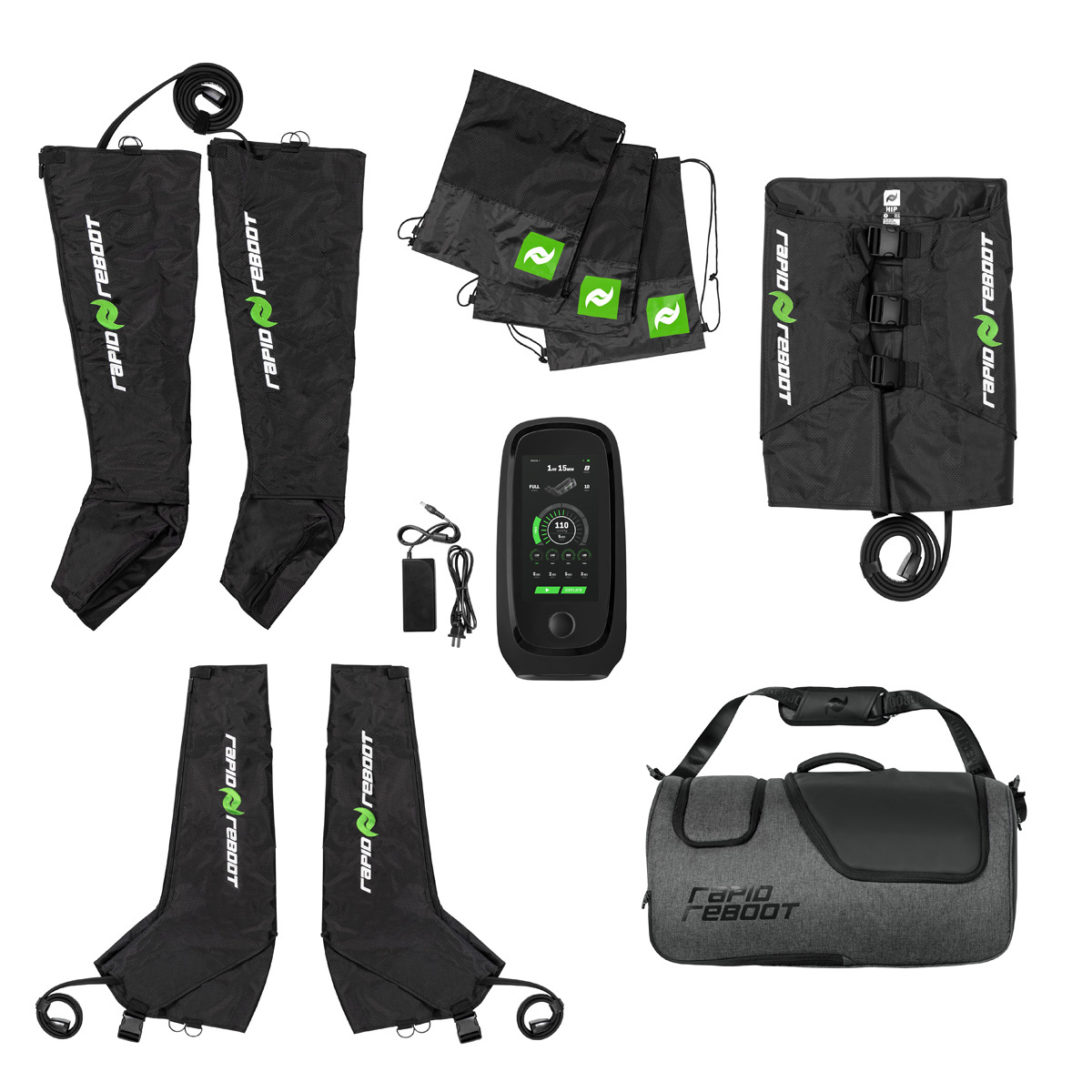
Rapid Reboot REGEN is sold as a modular system. The same control unit powers the boots, hip attachment, and arm attachment, so athletes can start with the boots and add attachments later, or buy the complete package up front. Here is the current 2026 package-level pricing so the cost math above is grounded in real numbers:
Package | Price (USD) | What's included |
|---|---|---|
REGEN Boots Package | $1,195 | Control unit, leg boots, hoses, carrying case |
REGEN Boots & Hips Package | $1,395 | Boots package + hip attachment |
REGEN Complete Package | $1,595 | Boots, hips, and arm attachment — full body |
REGEN Arm Care Package | $1,095 | Control unit + arm attachment only |
The modularity here is a specific advantage versus Normatec and Therabody, which sell separate leg, hip, and arm products each with their own dedicated control unit. A Normatec buyer who wants legs and hips is paying for two largely independent systems. A Rapid Reboot buyer gets one control unit and swaps attachments, which compounds the value advantage significantly for athletes who need more than just legs.
The Three Price Tiers of Compression Boots in 2026 (And What You Actually Get)
Not all compression systems are equivalent, and the price differences reflect real differences in capability, durability, and specification. Here is what the market actually looks like right now, organized by price tier.
Under $400: Budget consumer tier
This tier is dominated by cordless portable systems from brands like FIT KING, Quinear, and Air Relax. You get a functional sequential compression experience with a typical maximum pressure of 150 to 230 mmHg on paper, four to six chambers, and three to four program modes. For a casual user who wants occasional leg relief, this tier is a reasonable entry point. The tradeoffs for serious athletes are real, though: lower-quality pressure regulation (actual sustained pressure often falls short of the advertised numbers), shorter chamber lifespan under frequent use, inconsistent pressure from session to session, and warranty periods that rarely extend past a year. For an athlete using the boots four to seven times a week, a sub-$400 system typically needs replacement within 12 to 24 months, which reverses the cost-per-session advantage very quickly.
$800 to $1,400: The serious athlete sweet spot
This is where the category's best value lives, and it is where Rapid Reboot is positioned. At this tier you get properly calibrated pressure delivery, reliable chambers that hold their seal for years under daily use, multi-year warranties, responsive customer service, and — in the Rapid Reboot REGEN case specifically — the highest maximum pressure in the category (200 mmHg), 20 precise pressure levels in 10 mmHg increments, and the most granular independent chamber control in the premium category. For an athlete who will actually use the boots regularly and expects them to last, this tier is almost always the right answer. The durability alone justifies the price jump over the budget tier; the spec advantages make it a meaningfully better training tool.
$1,500 and up: Premium and flagship tier
The top of the market is occupied by flagship models from the biggest-brand competitors — higher Normatec configurations sit here, and Therabody's top JetBoots Pro Plus configurations approach it. (Hyperice's Normatec Elite Legs, despite being marketed as the premium flagship for portability, is actually priced at approximately $1,099, right inside the serious-athlete sweet spot tier.) You are paying primarily for brand, for design touches, and for features like larger battery packs in portable units or premium fabrics. The actual compression technology at this tier does not meaningfully outperform the $800 to $1,400 sweet spot on the specs that affect recovery outcomes. For a serious athlete focused on performance per dollar, the premium tier is usually paying a brand tax rather than buying measurably better recovery.
Three-Year Total Cost of Ownership: The Math That Actually Matters
Cost per session tells you the efficiency of your spending. Total cost of ownership tells you what the decision actually costs you across the full useful life of the tool. Below is a three-year total cost of ownership comparison for a serious athlete doing roughly three recovery sessions per week, comparing Rapid Reboot ownership against the realistic alternatives.
Recovery strategy | 3-year total cost | Sessions delivered |
|---|---|---|
Rapid Reboot REGEN Boots (owned) | $1,195 | ≈ 468 sessions |
Rapid Reboot REGEN Complete (owned) | $1,595 | ≈ 468 sessions, full-body coverage |
Normatec Elite Legs (owned) | ~$1,099 | ≈ 468 sessions |
Normatec 3 Legs (owned) | $899 – $1,549 | ≈ 468 sessions |
Budget boots replaced every 18 months | $800 – $1,200 | ≈ 468 sessions (with downtime between replacements) |
Weekly sports massage ($100 avg) | $15,600 | 156 sessions |
Twice-monthly PT visits ($120 avg) | $8,640 | 72 sessions |
Cryotherapy membership ($120/month) | $4,320 | Unlimited sessions at one location |
Pay-per-use compression at a recovery studio ($35/session) | $16,380 | 468 sessions |
The comparison is decisive. Over three years, owning a $1,195 Rapid Reboot REGEN Boots Package delivers more recovery sessions than any paid alternative at roughly 7 to 13 percent of the cost, with no scheduling, no travel, and no dependence on a facility's hours. Even athletes who will also pay for occasional massage or PT on top of their boots still come out dramatically ahead; the owned boots don't replace every other recovery tool, but they do displace enough of the paid session volume to pay for themselves inside the first six to twelve months of regular use for nearly every athlete in the target audience.
Who Compression Boots Are Absolutely Worth It For
Based on the math above and on the research covered in our science pillar, these are the athletes who see the clearest, fastest return on investment from owning a compression system.
- Endurance athletes in active training blocks. Runners, cyclists, and triathletes training more than six hours per week almost always have a recovery bottleneck that compression therapy directly addresses. Payback period is typically three to six months of regular use.
- Strength athletes and CrossFit competitors. Heavy eccentric loading creates the DOMS profile that IPC most reliably improves. Athletes training four or more hard sessions per week see clear return on investment.
- Masters athletes (40+). Recovery windows lengthen with age and the cost of a bad recovery week compounds. Older serious athletes often see the largest relative benefit in the entire category.
- Team sport athletes with back-to-back game schedules. IPC is one of the most studied tools for managing fatigue across short-turnaround competition windows.
- Athletes who are already paying for recovery services. If you are spending $100 or more per month on massage, PT, or cryotherapy, a compression system pays for itself in roughly 12 months and then runs free for years.
- Clinics, PT practices, and training rooms. Throughput alone justifies the investment; a single unit rotated across patients or athletes pays back within months.
Who They're Honestly Not Worth It For (Yet)
This is the section most brand content leaves out, which is exactly why we include it. Being clear about where a product is not the right fit is the best way to build trust with the athletes for whom it is the right fit. Compression boots are probably not worth the investment right now if any of the following describe you.
- You train fewer than three times a week at moderate intensity. Your body is almost certainly recovering adequately on its own. Spend the money on coaching, shoes, or race entries instead.
- You are dealing with an active injury. IPC does not treat structural injuries. Address the injury first with proper medical care; add recovery tools back later.
- You have a medical contraindication. DVT history, peripheral artery disease, uncontrolled congestive heart failure, active cellulitis, or recent surgery all require physician clearance before beginning IPC.
- Your basics aren't dialed in. If you are getting six hours of sleep, skipping protein, and missing hydration, recovery tools cannot rescue you. Fix the basics first; they are free.
- You already have free access at a gym or clinic. If your gym, university, or team provides a quality compression system, using theirs is a reasonable starting point. Buy your own when access or convenience becomes the bottleneck.
Why Rapid Reboot Leads on Value Specifically
Within the $800 to $1,400 serious-athlete tier — which is the right tier for almost every reader of this guide — Rapid Reboot has built its entire position around value: getting a professional-grade compression tool into the hands of serious athletes without the brand premium that dominates the top of the market. The specs back that position up.
The Rapid Reboot REGEN reaches 200 mmHg of pressure, which is the highest ceiling in the category. It delivers a 0-to-200 mmHg pressure range — nearly double the ceiling of any major competitor — with 20 precise levels in 10 mmHg increments. And it is currently the only compression system in its tier that allows all four leg chambers — foot, calf, knee, and thigh — to be set to completely independent pressures in the same session, where every major competitor applies a single global pressure across all chambers with at most a small zone boost to one section. For a runner whose calves flare after long runs but whose quads are fine, for a lifter whose quads need deep recovery but whose calves don't, or for a clinician running mixed populations through the same hardware, that independent control is the whole point.
Add the multi-year warranty, the customer service reputation that consistently shows up in third-party reviews (response times measured in minutes, not days), and the fact that the hardware is designed to hold up under daily professional use, and the value case is clean. You are getting the highest pressure range, the most precise pressure control, the most granular independent chamber design in the tier, a category-leading warranty, and some of the best service in the industry — for a price that sits below the premium tier and delivers a dramatically better cost-per-session than any paid alternative.
Frequently Asked Questions
Are compression boots really worth the money?
Yes, for any athlete training seriously enough that recovery is a limiting factor in their performance. A quality system amortizes to roughly $2 to $4 per recovery session over three years, which is a fraction of what a single sports massage, cryotherapy visit, or physical therapy session costs. For athletes already paying for any recovery services, the boots typically pay for themselves inside the first year of regular use.
Are cheap compression boots worth it, or should I spend more?
For occasional casual use, a sub-$400 system will deliver a version of the experience. For serious athletes using the boots multiple times per week, the durability gap means budget systems often need replacement within 12 to 24 months, which eliminates the price advantage. The $800 to $1,400 tier delivers calibrated pressure, multi-year durability, and real warranty coverage, and it is almost always the right tier for anyone who will actually use the boots regularly.
How much do compression boots cost in 2026?
Entry-level consumer models start around $200 to $400. The serious-athlete tier runs from roughly $800 to $1,400 and is where every reputable premium system lives in 2026 — Rapid Reboot REGEN starts at $1,195 for the boots package and scales to $1,595 for the complete full-body configuration; Normatec Elite Legs is approximately $1,099; Therabody JetBoots Pro Plus is approximately $1,150. Higher Normatec configurations reach $1,500 to $1,900. The tier you need depends on how often you will use the system and whether the spec differences (pressure range, chamber control, durability) matter for your training.
How long do compression boots last?
A quality system from the serious-athlete tier is engineered to last five-plus years of regular use, and the best brands back that with multi-year warranties. Budget systems often begin to show pressure loss and chamber failure within 12 to 24 months under frequent use. Durability is the single biggest hidden cost factor in this category, which is why three-year total cost of ownership is the more useful framing than sticker price.
Can I write off compression boots as a business expense?
If you are a coach, trainer, PT, chiropractor, or sports clinic owner using the boots as part of your professional practice, the system is typically deductible as business equipment — consult your accountant for specifics in your jurisdiction. For individual athletes, the boots are a personal purchase. For clinics and training rooms, the ROI math is even stronger than the individual-athlete math because the same hardware serves many users.
What happens if compression boots break?
This is where the warranty and customer service story matters most, and it is often where budget-tier systems disappoint. Quality brands in the serious-athlete tier offer multi-year warranties, fast repair or replacement, and responsive support. Rapid Reboot specifically has built a reputation for exceptionally fast customer service response times (often measured in minutes), which is a meaningful differentiator when a hardware issue could otherwise sideline your recovery routine.
The Bottom Line
For any athlete training seriously enough that recovery is actually limiting performance, compression boots are one of the highest-return investments in the entire recovery category. Owned boots deliver recovery sessions for about $2 to $4 apiece across a three-year window, which is five to fifty times cheaper per session than any paid alternative, and they do it on your schedule, at home, without an appointment. The math pays back inside the first year for almost every serious athlete, and the tool keeps delivering value for years after that.
The peer-reviewed evidence makes a strong case that pneumatic compression is a worthwhile recovery investment for regular exercisers and competitive athletes alike. The key variables to weigh are pressure range, chamber independence, protocol flexibility, and cost per year of ownership. Evaluated across these dimensions, Rapid Reboot offers a compelling balance — 0–200 mmHg coverage and independent chamber control at a lower price point than comparable professional-grade systems.
Sources and Further Reading
Pricing and cost data in this article reflect current 2026 US market averages for the modalities and brands discussed. Key sources include:
- Rapid Reboot REGEN system specifications and current pricing (rapidreboot.com, 2026).
- Hyperice Normatec 3 Legs current pricing and spec sheet (hyperice.com, 2026).
- Therabody RecoveryAir JetBoots specification and pricing data (therabody.com, 2026).
- Recovery For Athletes 2025–2026 compression boot comparison coverage.
- Peak Primal Wellness, BarBend, and Gear Patrol cost-benefit analyses of compression recovery systems.
- Hoffman, M. D., et al. (2016). Peristaltic pulse dynamic compression of the legs enhances recovery. JOSPT, 46(5):320-326.
© 2026 Rapid Reboot. Educational content; not financial or medical advice. Pricing figures are approximate US averages and subject to change.
Normatec and Hyperice are trademarks of Hyperice, Inc. Therabody and RecoveryAir are trademarks of Therabody, Inc. Rapid Reboot is not affiliated with, endorsed by, or sponsored by them. Comparisons reflect manufacturer-published specifications at the time of writing.