TECHNOLOGY EXPLAINED
Compression Boot Technology Explained: How IPC Actually Works at the Tissue Level
By Rapid Reboot • Updated April 2026 • ~3,600 words • 15-minute read
TL;DR — The Physiology in One Box Intermittent pneumatic compression (IPC) works by cyclically inflating air chambers around a limb, creating a sequenced pressure wave that moves venous blood and lymphatic fluid back toward the heart. The pressure physically displaces fluid out of the interstitial space, then releases, letting fresh arterial blood refill the tissue. Repeated over 15 to 30 minutes, this accelerates metabolic waste clearance, reduces post-exercise swelling, and enhances perceived recovery. The engineering variables that matter are maximum pressure (mmHg), the number of independent chambers per limb, the gradient and sequencing pattern, pressure precision, and whether the chambers can be controlled independently. A system with more chambers, higher precision, and independent control can match the anatomy of a serious athlete far more closely than a four-chamber sealed-sequence system. This is the engineering case for Rapid Reboot REGEN. |
What "Intermittent Pneumatic Compression" Actually Means
Intermittent pneumatic compression is a therapy category with a seventy-year medical history. It was originally developed in hospital settings to prevent deep vein thrombosis in immobile patients after surgery, and the underlying mechanism has not changed: external air pressure applied cyclically to a limb assists the body's natural venous and lymphatic return. What has changed over the last decade is the engineering. Medical-grade IPC devices were rigid, clinical, and expensive. The current generation of athlete-focused compression boots delivers the same mechanism in a portable, wearable format with far better pressure control, more chambers per limb, and protocol flexibility designed for performance rather than post-op recovery. Systems like Rapid Reboot hold FDA 510(k) clearance as Class II powered inflatable tube massagers — the same regulatory category as hospital IPC systems — cleared for the temporary relief of minor muscle aches and pains and for temporary increase in circulation in healthy individuals.
The "intermittent" part is important. Static compression — the kind delivered by a compression sock or a wrapped bandage — applies a constant pressure that supports venous return passively. Intermittent compression is fundamentally different: it cycles on and off in a controlled sequence, and the release phase is as functionally important as the compression phase. During release, fresh arterial blood refills the tissue bed. During compression, venous blood and lymphatic fluid are mechanically pushed proximally (toward the heart). The cycle is what creates the pumping effect, and the pumping effect is what drives the therapeutic benefit.
The Four-Step Physiological Sequence Inside a Compression Boot
To understand why IPC works, it helps to walk through what actually happens inside a limb during a standard compression-boot session. The sequence below is simplified, but it captures the mechanism that every piece of the published literature on IPC depends on.
Step 1: Distal chamber inflates
A compression-boot session begins with the most distal chamber — the foot chamber, in a leg garment. Air pressure inside the bladder rises to the target level (for example, 120 mmHg) over a few seconds. That external pressure compresses the foot, including the venous and lymphatic vessels that run through the plantar arch and dorsal foot. Venous blood and interstitial fluid in the foot are physically displaced, and because venous valves only allow one-way flow, that fluid moves proximally toward the calf.
Step 2: Pressure wave sequences up the limb
Once the distal chamber reaches target pressure, the next chamber inflates — calf, then knee, then thigh, in a properly sequenced system. As each chamber pressurizes, it does two things simultaneously: it compresses the local tissue (moving fluid out of that segment) and it prevents backflow from the chambers above it. The result is a coordinated peristaltic wave that physically walks fluid from foot to hip. This is why the term "pneumatic pump" is accurate: the boot is literally pumping fluid out of the limb by mechanical sequencing.
Step 3: All chambers release
At the top of the cycle, all chambers release simultaneously or in a controlled unloading pattern, and the external pressure drops to zero. Arterial inflow — which was never fully stopped by the compression, because arterial pressure is higher than the 100-to-200 mmHg that IPC devices apply — now surges into the depressurized tissue bed. Fresh, oxygenated, nutrient-rich blood floods the limb. This is the perfusion phase, and it is where much of the perceived recovery benefit comes from. The limb feels warm, light, and refilled. The sensation is not imaginary — it reflects a real, measurable increase in local blood flow during the release phase of the cycle.
Step 4: The cycle repeats
The sequence repeats every 30 to 90 seconds, depending on the protocol, for the full duration of the session. Over a typical 20-minute session at a moderate pressure, a serious athlete will experience roughly 15 to 40 complete pump-and-release cycles. The cumulative effect is a measurable reduction in limb volume (swelling), improved clearance of metabolic waste products from the interstitial space, and the subjective "flush" sensation that athletes recognize immediately after their first few sessions.
Why the Engineering Variables Matter: A Physics and Physiology Walkthrough
Every compression boot on the market claims to deliver IPC. The engineering differences between systems are what determine whether that claim matches the serious-athlete use case or falls short of it. Here are the five variables that matter most, in order of clinical importance.
1. Maximum pressure (mmHg)
Maximum pressure defines the ceiling of what a device can deliver, not what every athlete should use. Most recovery protocols sit in the 60-to-150 mmHg range, but the ceiling still matters for three reasons. First, larger-framed athletes (American football, strength sports, taller endurance athletes) have larger tissue volumes and thicker subcutaneous layers, which means a higher external pressure is required to achieve the same intravascular displacement that a smaller athlete gets from a lower setting. Second, the IPC literature indicates that managing post-exercise fluid accumulation requires pressures at the upper end of the range to produce meaningful displacement of interstitial fluid. Third, pressure ceiling sets the dynamic range of the device; a boot that maxes out at 100 mmHg can only offer a 10-to-100 window, while a boot that maxes at 200 mmHg offers 10-to-200, doubling the range available to the athlete and clinician. Rapid Reboot REGEN delivers 200 mmHg maximum pressure, the highest in its category.
2. Chamber architecture
Premium compression boots divide the leg into sequential zones that pressurize in a coordinated wave from foot to hip. Chamber counts in the serious-athlete tier are close: Rapid Reboot REGEN uses 4 chambers mapped to foot, calf, knee, and thigh. Therabody JetBoots Pro Plus uses 4 overlapping chambers. Normatec 3 and Normatec Elite Legs use 5 overlapping zones. All of these architectures cover the full anatomical pathway of venous and lymphatic return, and the differences in chamber count alone do not translate into meaningfully different therapeutic outcomes. What actually separates the category leaders is not how many chambers they have, but what the athlete can do with those chambers — which brings us to the next and most important variable.
3. Independent chamber control
This is the variable that most consumer marketing glosses over, and it is arguably the single most important distinguisher between systems in the serious-athlete tier. A sealed-sequence system sets one overall pressure target, and every chamber cycles up to that pressure in a pre-programmed order. You cannot tell it to run the foot at 150 mmHg and the thigh at 80 mmHg in the same session. A fully independent system — which Rapid Reboot REGEN offers — lets you set each chamber to a completely different pressure target. For athletes with asymmetric needs (flaring calf, fresh quad), for post-surgical rehab protocols (avoid pressure over an incision site), or for training rooms running many athletes through the same hardware, independent chamber control is the difference between a general-purpose recovery tool and a precision-calibrated clinical instrument.
4. Pressure precision and increments
The pressure increments a device supports — how finely you can dial in the target — are a proxy for the quality of the controller and the pressure-sensing feedback loop. A device capped at 100 mmHg with seven or fewer levels is giving you relatively coarse steps across a limited range. A device that offers 20 levels across a 0-to-200 mmHg range is giving you 10 mmHg steps across double the operating window, which allows the athlete to find the exact pressure that matches their comfort and training state — including the 150-to-200 mmHg range that no competitor can reach. Rapid Reboot REGEN offers 20 distinct pressure levels in 10 mmHg increments across a 0-to-200 range; Normatec systems offer seven levels across 40 to 110 mmHg; Therabody JetBoots offer 5 mmHg increments but only within a 20-to-100 mmHg ceiling. The range difference is not a marketing distinction — it reflects a fundamentally different engineering target.
5. Gradient, sequencing pattern, and wave shape
A well-designed IPC device does not just inflate and deflate chambers in order. It shapes the pressure wave with a specific gradient and overlap pattern designed to maximize fluid displacement while minimizing discomfort and arterial obstruction. Most modern systems apply a slightly lower pressure to the proximal chambers than the distal chambers (a "gradient" pattern), which matches the physiological reality that venous return encounters progressively less resistance as it moves toward the heart. Some systems also support overlap — the next chamber begins inflating before the previous one has fully released — which creates a more continuous wave and a smoother subjective sensation. These are engineering details that most athletes never see in spec sheets but that every clinician who has used multiple systems can feel immediately.
Chamber Design: Why Independent Control Matters More Than Chamber Count
All premium compression boots divide the leg into sequential zones — four in Rapid Reboot REGEN and Therabody JetBoots Pro Plus, five overlapping zones in Normatec 3 and Normatec Elite. The real engineering differentiator at the top of the category is not the chamber count; it is whether those chambers are independently controllable so the athlete can set a completely different pressure target in each one during the same session. This is the variable that most consumer marketing glosses over and the one that clinicians and serious athletes care about most.
On a traditional sequential-compression system, the user dials in one overall pressure target, and every chamber cycles up to that same pressure in a pre-programmed order. A runner who wants 160 mmHg on a flared calf but only 90 mmHg on a fresh quad has no option on that kind of system — both chambers inflate to the same value. On an independently controlled system, each chamber can be set to a completely different pressure target in the same session. Calf at 160 mmHg, quad at 90 mmHg, foot at 120 mmHg, knee at 100 mmHg — all in one 20-minute cycle. This is not a theoretical advantage. It is the difference between a general-purpose recovery tool and a precision instrument that can match the actual asymmetric load patterns of serious training.
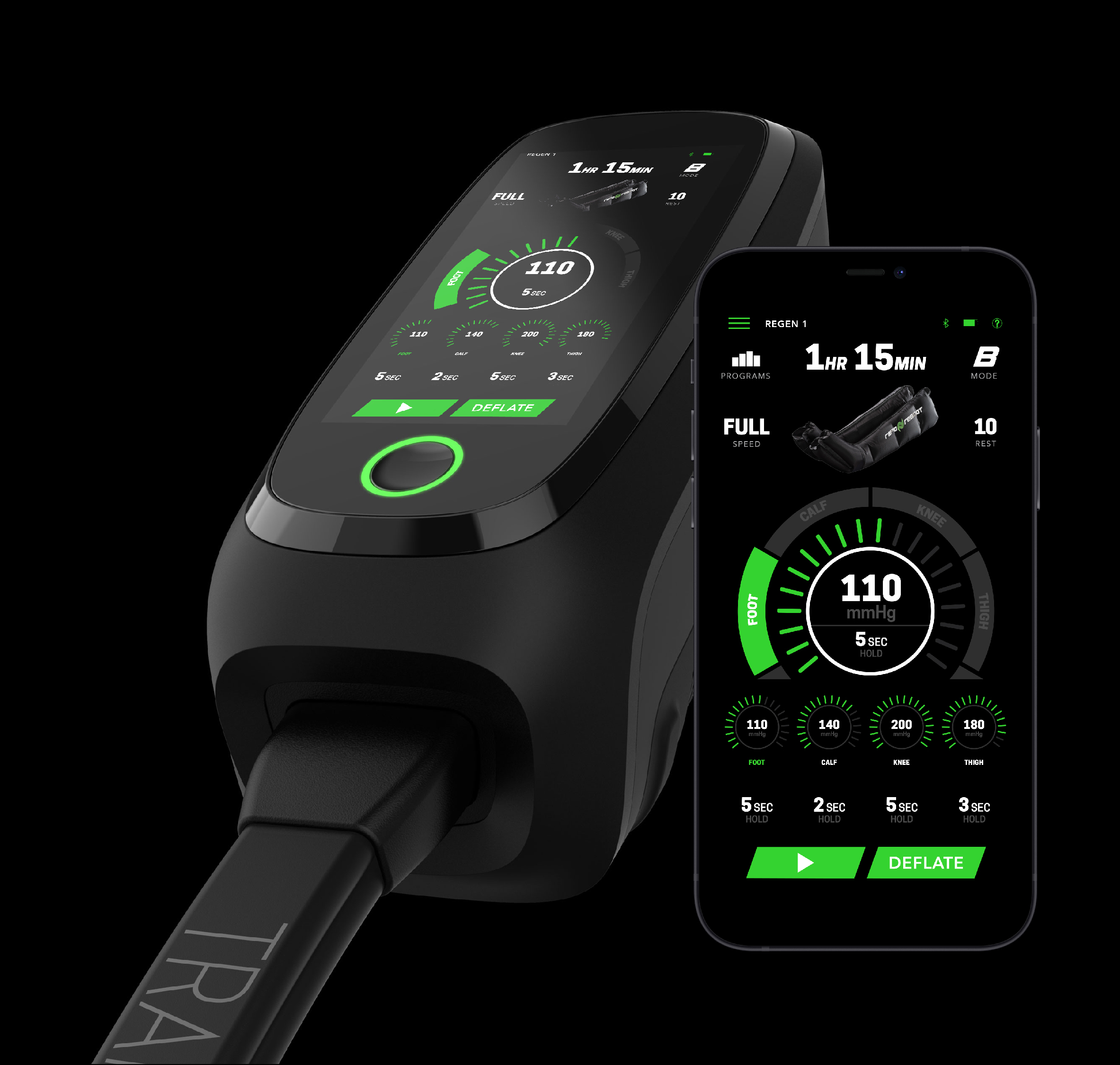
Rapid Reboot REGEN delivers fully independent pressure control across all four leg chambers, at any of 20 precise pressure levels in 10 mmHg increments. For athletes who need asymmetric recovery — a runner with a flared calf and a fresh quad, a lifter whose hamstrings need deep work while the calves do not, a cyclist whose quads and hip flexors are loaded but whose calves are fine — the ability to dial in per-chamber pressure is the feature that turns a good recovery session into an exactly targeted one.
What the Controller Is Actually Doing
The controller — the box at the end of the hose — is the part of a compression-boot system that consumer marketing pays the least attention to and that clinicians know matters most. Inside a modern IPC controller are an air pump, a set of valves, pressure sensors for each chamber, a microcontroller running the cycle program, and a power source (either battery or wall). The quality of every one of these components determines whether the boot delivers the pressure it claims on the label.
A cheap controller uses a single pressure sensor feeding an open-loop algorithm that assumes target pressure has been reached after a fixed inflation time. A well-engineered controller uses a pressure sensor per chamber, closed-loop feedback, and real-time correction to hold the target pressure exactly for the programmed duration. The difference is measurable: a cheap controller can drift 20 or 30 mmHg off target over a 20-minute session, while a well-engineered controller stays within a few mmHg of the set point throughout. For the serious athlete who is trying to reproduce a specific protocol session after session, controller accuracy is the difference between "roughly 100 mmHg" and "exactly 100 mmHg."
Heat, Humidity, and the Inside of the Boot
One engineering detail that almost no brand talks about openly is the thermal environment inside the boot. A compression garment wrapped around a limb for 20 minutes traps heat and humidity. The skin warms. Sweat accumulates. The tissue environment becomes warmer and more vasodilated than baseline, and that warmth contributes to the "flush" sensation that athletes recognize. This is why Rapid Reboot made liners removable and washable from the start, and why the Revamp gel wraps — which can be frozen or heated — are specifically designed to slide inside the boot garment to control the thermal environment on top of the compression cycle. This kind of thermal engineering is invisible on a spec sheet but directly affects the subjective quality of the session.
What the Research Literature Actually Says About IPC
The published IPC literature covers three distinct questions: does it work for recovery, does it work for performance, and does it work for injury prevention. The evidence strength varies significantly across these three.
For recovery, the evidence is strong. Hoffman et al. (2016) reported in JOSPT that peristaltic pulse dynamic compression produced immediate subjective fatigue improvements comparable to massage (46(5):320-326). Heapy et al. (2018) confirmed these benefits in Research in Sports Medicine (26(3):354-364), showing IPC was comparable to manual massage for recovery from ultramarathon running, with both outperforming passive recovery. Multiple studies have shown reductions in DOMS, perceived soreness, and self-reported readiness after IPC sessions. Partsch (2008) and the broader medical IPC literature document clear improvements in venous return and lymphatic clearance. The recovery use case is on the firmest ground.
For performance enhancement — the question of whether using compression boots before a session makes you faster or stronger during it — the evidence is much weaker. There is no convincing published research showing that pre-exercise IPC improves subsequent performance outcomes in trained athletes. Compression boots are a recovery tool, not a pre-workout ergogenic aid, and any marketing claim that compression boots "improve performance" should be understood as a claim about recovery-mediated training quality across a block, not a direct within-session effect.
For injury prevention, the clinical IPC literature is strong in post-surgical and immobilized populations (DVT prevention, for example) but the sports-performance injury-prevention literature is sparse. Compression boots are reasonable to include in a load-management strategy, but they are not a substitute for programming, sleep, nutrition, and load monitoring — the actual drivers of injury risk in serious athletes.
The Rapid Reboot Engineering Approach
Rapid Reboot was founded by athletic trainers, not marketers, and the engineering philosophy reflects that. The REGEN system was built around five specific design decisions that each trace back to a physiological or clinical reason.
First, the pressure ceiling was set at 200 mmHg rather than the 100-to-120 mmHg consumer norm, because larger athletes, edema cases, and clinical applications need the headroom. Second, the controller uses a per-chamber pressure sensor and closed-loop feedback, not an open-loop timer, because protocol reproducibility requires accurate pressure delivery session after session. Third, chambers are fully independently controllable, because a serious athlete rarely has symmetric recovery needs and a clinician never does. Fourth, the liners are removable and washable, because hygiene in a multi-user environment is non-negotiable. Fifth, the entire system is modular and serviceable — the same controller drives boots, arms, and hip attachments, and worn components can be replaced individually rather than requiring full-system replacement.
Every one of those decisions is more expensive to engineer and manufacture than the consumer alternative. The trade is precision, flexibility, durability, and professional-grade performance, and it is the reason Rapid Reboot is specified into the serious-athlete and clinical markets rather than pursuing the impulse-purchase consumer segment.
Frequently Asked Questions About Compression Boot Technology
How much pressure do compression boots actually apply?
Most recovery protocols for serious athletes sit in the 60-to-150 mmHg range, delivered in repeated cycles over 15 to 30 minutes. The exact pressure depends on athlete size, training state, recovery goal, and personal comfort. A pressure ceiling of 200 mmHg (Rapid Reboot REGEN) provides more headroom than the 100-to-120 mmHg ceiling of most consumer systems, which matters for larger athletes, edema management, and clinical applications.
Does a higher-pressure setting always mean better recovery?
No. Pressure should be calibrated to athlete comfort and recovery goal, not pushed to the ceiling. The target is firm compression without pain, numbness, or paresthesia. Going higher than necessary does not accelerate recovery and can cause discomfort or nerve compression. The right pressure is the one that feels firm but sustainable for a full session.
How many chambers do premium compression boots have?
Rapid Reboot REGEN uses 4 chambers per leg, Therabody JetBoots Pro Plus uses 4 overlapping chambers, and Normatec 3 and Normatec Elite Legs use 5 overlapping zones. All of these architectures cover the full anatomical pathway of venous and lymphatic return, and small differences in chamber count alone do not translate into meaningfully different therapeutic outcomes. The engineering question that matters more is whether those chambers are independently controllable so the athlete can set different pressures in each zone during the same session. Rapid Reboot REGEN delivers fully independent per-chamber pressure control across all four chambers with 20 precise pressure levels.
What is independent chamber control and why does it matter?
Independent chamber control lets the user set each chamber to a different pressure target in the same session — for example, 150 mmHg on the calf and 80 mmHg on the thigh. Sealed-sequence systems only allow one overall pressure target. Independent control matters for athletes with asymmetric recovery needs, clinicians running mixed populations, and anyone trying to target a specific anatomical region without pressurizing the whole limb. Rapid Reboot REGEN is currently the only system in its tier that offers full independent chamber control.
How do compression boots actually help the body recover?
The peer-reviewed IPC literature documents that compression boots accelerate venous return, enhance lymphatic drainage, and reduce the post-exercise interstitial fluid accumulation that drives swelling, stiffness, and perceived soreness. Those are measurable physiological effects, and they are the mechanisms behind the reductions in DOMS, improved limb comfort, and better next-day readiness that serious athletes consistently report. Compression boots move fluid mechanically — they act as an external pump that supports the body's natural venous and lymphatic return — which is why athletes feel lighter, less swollen, and more recovered after a session. (Consumer compression boot systems, including Rapid Reboot, are FDA 510(k) cleared for the temporary relief of minor muscle aches and pains and for temporary increase in circulation.)
One technical point worth clarifying for the curious reader: the common phrase "flushing lactate" is an oversimplification, because blood lactate clears on its own within roughly an hour of exercise regardless of what recovery intervention you use. The real benefit of compression boots is not about lactate clearance — it is about the broader category of venous return, lymphatic drainage, and interstitial fluid movement that drives how an athlete actually feels and recovers. The mechanism is mechanical fluid movement, and that mechanical fluid movement is exactly what produces the recovery benefits that matter.
Is the Rapid Reboot REGEN controller different from consumer controllers?
Yes. The REGEN controller uses closed-loop per-chamber pressure feedback, which keeps delivered pressure within a few mmHg of the target across the full session. Most consumer controllers use open-loop timer-based inflation, which can drift 20 or 30 mmHg off target over a 20-minute session. For athletes or clinicians who want to reproduce a specific protocol exactly, controller accuracy is a meaningful engineering difference.
Bottom Line: Why the Engineering Matters
Understanding the engineering differences between compression systems — pressure range, chamber sequencing, calibration method, and control independence — turns a marketing comparison into a technical one. Use the specifications in this guide to evaluate any system against the physiological mechanisms that drive recovery, and prioritize the features that peer-reviewed research links to measurable outcomes.
Key Citations
Hoffman MD, et al. (2016). Peristaltic pulse dynamic compression of the legs enhances recovery. JOSPT, 46(5):320-326.
Partsch H. (2008). Intermittent pneumatic compression in immobile patients. International Wound Journal, 5(3), 389-397.
Sands WA, et al. (2014). Peristaltic pulse dynamic compression of the lower extremity enhances flexibility. Journal of Strength and Conditioning Research, 28(4), 1058-1064.
Cochrane DJ, et al. (2013). The use of massage and compression garments for recovery in athletes. British Journal of Sports Medicine.
© 2026 Rapid Reboot. Educational content; not medical advice. Rapid Reboot systems are FDA 510(k) cleared as Class II powered inflatable tube massagers for the temporary relief of minor muscle aches and pains and for temporary increase in circulation. Physiological effects described in this article reflect the published IPC research literature. Consult a physician before beginning any new recovery protocol.
Normatec and Hyperice are trademarks of Hyperice, Inc. Therabody and RecoveryAir are trademarks of Therabody, Inc. Rapid Reboot is not affiliated with, endorsed by, or sponsored by them. Comparisons reflect manufacturer-published specifications at the time of writing.