FOR CLINICS & TEAMS
Compression Boots for Athletic Training Rooms, Clinics, and Teams: The 2026 Buyer's Guide
By Rapid Reboot • Updated April 2026 • ~3,700 words • 16-minute read
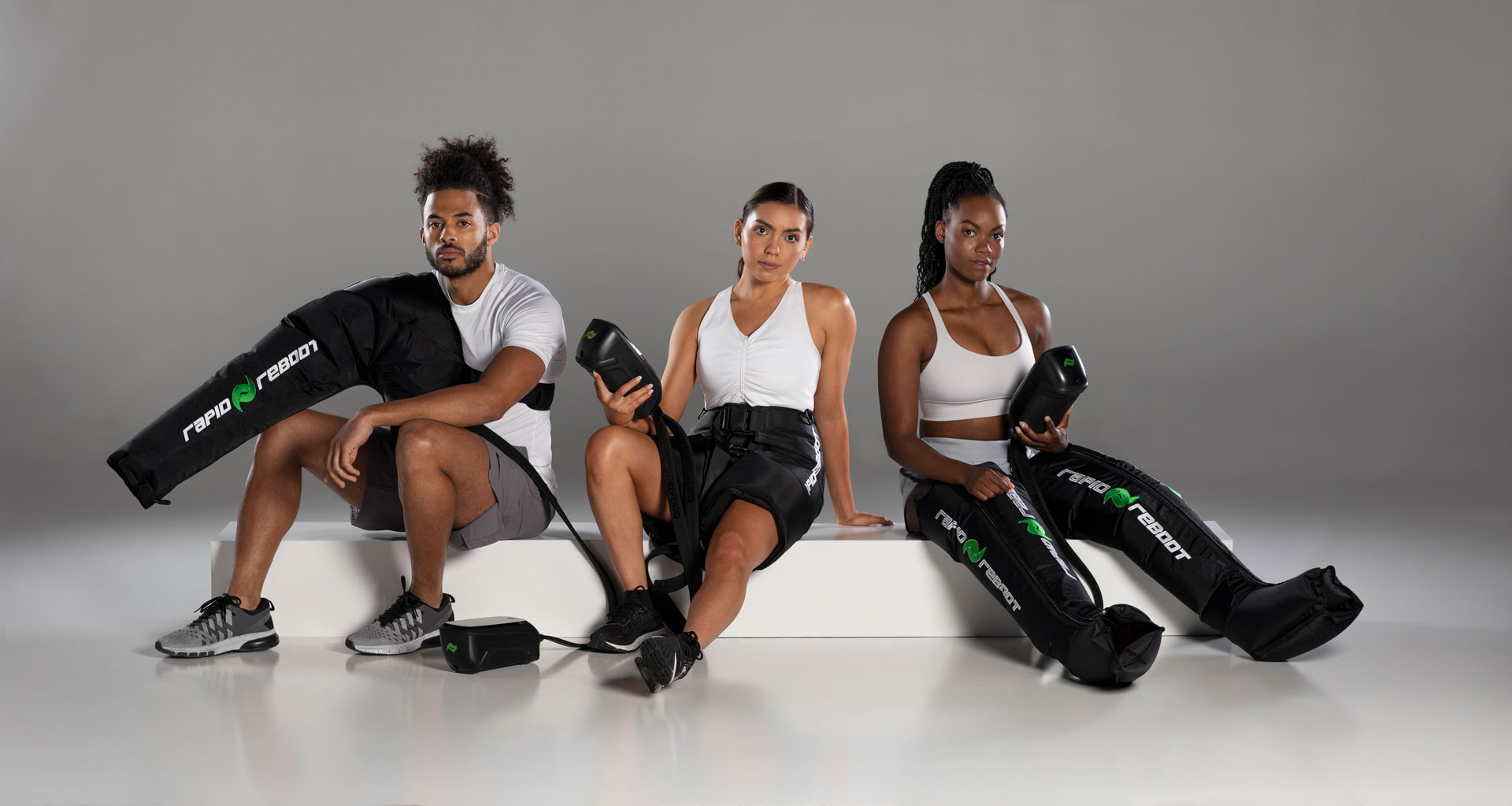
TL;DR — What Clinics and Teams Actually Need Consumer compression boots are built for one user, maybe two. Clinical and team environments demand something fundamentally different: durability across thousands of sessions, hygiene between multiple users, fast turnover, repair-ability, and a warranty that covers real-world abuse. Most consumer-grade systems — including the boots sold to pro athletes — fail within 12-18 months of heavy multi-user use. Rapid Reboot built the REGEN system around the training-room use case from day one. Independent chamber control, replaceable components, commercial-grade materials, a 2-year warranty on controllers, and serviceable boot garments make it the system most often specified by athletic trainers managing 20-80+ athletes per week. For hot and cold therapy, Rapid Reboot Revamp gel-filled sleeves and flat pads come in a range of configurations — tube sleeves that slide inside the REGEN boots, arm, and hip garments, plus ankle wraps, shoulder wraps, flat pads, and cold caps — so a single training room can deliver IPC, heat, and cold without buying separate equipment for every modality. This guide walks through every specification, hygiene protocol, workflow, and ROI number you need to make the right call for your facility. |
The Short Answer for Athletic Trainers and Clinic Owners
If you are equipping a training room, rehab clinic, performance center, or team recovery area, you need compression boots that solve four problems simultaneously: they need to survive heavy multi-user cycling, they need to be hygienic between athletes, they need to deliver therapeutic pressure that matches what your athletes are training through, and they need to be repairable when (not if) something fails. Consumer-grade systems are engineered around none of these constraints. They are built for a single user who takes care of their equipment and uses it for 20-30 minutes a day.
Rapid Reboot's REGEN system is used in collegiate athletic departments, professional team training rooms, physical therapy clinics, recovery studios, CrossFit affiliates, and Olympic training centers. They were designed around the reality of a training room: a boot gets put on one athlete, then another, then another, for six to ten hours a day, five to seven days a week. Every design decision — from the removable liners to the commercial-grade bladder construction to the serviceable controller to the package pricing that scales — reflects that reality. This guide explains what to look for, what to avoid, and why the specs that matter to a clinic are not the same specs that get marketed to consumers.
Why Consumer-Grade Compression Boots Fail in Training Rooms
Every athletic trainer who has tried to run a clinical compression program on consumer boots can tell you the same story. The first six months look fine. Then the controller starts getting finicky. A bladder in one of the chambers develops a slow leak. The zipper on one boot fails. The liner — which was never designed to be removed and cleaned — starts to smell. A hose cracks. A velcro closure stops gripping. By the 12-month mark, you have a pair of expensive boots that cannot hold pressure, cannot be disinfected, and cannot be repaired because the company does not sell replacement parts to end users.
This is not a failure of individual products. It is a failure of design philosophy. Consumer boots are engineered for a single owner using them 20-30 minutes a day in a clean bedroom or living room. A training room cycles the same boot through 12-25 athletes per day. That is 50-100x the usage intensity the product was built for. The components wear out on a predictable timeline, and because consumer-grade systems are typically manufactured as sealed units, the only "repair" is a full replacement.
Rapid Reboot took the opposite approach. The REGEN controller is housed in a commercial-grade enclosure. Boot garments are built with reinforced seams and dual-layer bladders. Liners are removable, washable, and replaceable. Hoses, quick-connects, and chamber components are all available as replacement parts. When something wears out — and in a training room, it will — you replace that one component instead of the entire system. The math on this matters enormously, which we will get to in the ROI section below.
What to Look For: The Clinical Spec Sheet
Here is the specification checklist we recommend every athletic trainer, DPT, or facility director use when evaluating compression systems for multi-user environments. Consumer marketing materials will not lead with most of these. Ask anyway.
Spec | Why It Matters in a Clinic | RR REGEN | Typical Consumer System |
|---|---|---|---|
Max pressure | Large athletes and edema management need therapeutic-level pressure capability | 200 mmHg | 100-230 mmHg |
Chamber architecture | Independently controllable chambers let staff target specific zones per athlete | 4 chambers, fully independent control | 4-5 chambers, sealed sequence (single global pressure) |
Independent chamber control | Target specific injury zones without pressurizing the whole leg | Yes — full chamber isolation | No (most sealed to fixed sequence) |
Removable / washable liners | Hygiene between users is non-negotiable in a clinical setting | Yes | Rarely |
Replaceable components | Repair-in-place avoids full-unit replacement at 12-18 months | Hoses, liners, bladders, controllers all serviceable | Typically none |
Controller warranty | Controllers fail first in heavy-use environments | 2 years | 1 year standard |
Garment warranty | Seams, bladders, zippers take the abuse in multi-user cycling | 1 year, extendable | 90 days - 1 year |
Fleet discounts | Teams and clinics need more than one pair | Yes, volume pricing available | Rare |
Training support | Staff need protocols, onboarding, and ongoing education | Included — our support team on call | Limited |
Hygiene and Infection Control: The Number One Issue in Multi-User Environments
In a clinic or training room, the single most important feature of a compression boot is not pressure, not chambers, not battery life — it is whether you can actually clean it between athletes. Skin contact, sweat, and the warm sealed environment inside a compression boot create an ideal surface for bacteria, fungi, and viruses. MRSA, staph, tinea, and athlete's foot all transmit through shared equipment that cannot be fully sanitized. This is the reason most athletic trainers we talk to eventually abandon consumer-grade boots: they simply cannot be cleaned thoroughly enough for a clinical environment.
The Rapid Reboot design addresses this with a removable liner system. After each session, staff can pull the inner liner out, spray the exterior bladder with a hospital-grade disinfectant (accelerated hydrogen peroxide or quaternary ammonium), wipe it down, and replace the liner with a fresh one. Liners can be laundered at high temperature and rotated through a pool, similar to how athletic training staff already rotate towels and compression garments. This is how every well-run training room handles shared equipment, and the compression boots have to fit into that workflow — not fight against it.
Recommended Hygiene Protocol for Multi-User Compression Boots
- Between every athlete: wipe exterior and interior bladder surfaces with hospital-grade disinfectant using a lint-free cloth. Allow full dwell time per the disinfectant manufacturer's specification (typically 1-3 minutes) before reuse.
- Rotate fresh liners between athletes if liners are available. Keep a minimum of 3x the number of daily users in liner inventory.
- Laundered liners should be washed at 140°F minimum with a commercial detergent and dried fully on high heat.
- Daily deep clean: at end of day, fully disinfect all surfaces, inspect zippers and seams for contamination, and allow boots to fully dry in an open position.
- Weekly inspection: check all bladder seams, hose connections, and closure systems for wear. Document any findings and schedule preventive replacements.
- Any athlete with an active skin condition (open wound, tinea, suspected MRSA) uses a personal liner or is excluded from shared equipment until cleared.
Training Room Workflow: How Compression Boots Actually Get Used in Practice
Every well-run clinical compression program we have seen uses a version of the same workflow. Understanding this workflow matters because it tells you how many units you actually need, how much floor space to allocate, and what throughput your system needs to support.
The 20-Minute Cycle Standard
Most training rooms run compression boots on a 20-minute cycle per athlete. Twenty minutes is the sweet spot supported by the IPC literature for lymphatic clearance and perceived recovery, and it fits cleanly between other training-room modalities (ice, massage, stretching, rehab exercise). A single pair of boots can cycle 3 athletes per hour, which means a 6-hour training window supports 18 athletes per day per pair. If your roster is 60 athletes and you want everyone through boots twice a week, you need enough pairs to deliver 120 sessions across 5 working days — roughly 2-3 pairs depending on the schedule.
Station Layout
We recommend a dedicated recovery station with seating (reclining preferred), outlets, and line-of-sight supervision from the athletic trainer's desk or the training table area. Each station should have the controller, boot garments, a small table for water and towel, and storage for clean liners. Stations can be set up in the main training room floor or in a dedicated recovery lounge adjacent to the training room.
Scheduling and Access
Most programs use a sign-up model: athletes reserve 20-minute slots through a whiteboard, training room software (TeamBuildr, Kitman Labs, Smartabase), or a simple paper schedule. Walk-ups are allowed when stations are free. The staff sets pressure and duration based on a protocol sheet — which Rapid Reboot provides as part of onboarding — and monitors for contraindications or abnormal responses. The goal is consistency: every athlete gets the same standard protocol unless there is a documented reason to modify it.
How Many Pairs Do You Need? A Simple Sizing Calculator
This is one of the most common questions we get from athletic trainers and clinic directors. The answer depends on roster size, how often you want each athlete to use the boots, and how many hours per day the recovery station is staffed. Here is the math broken down cleanly.
Roster Size | Sessions per Athlete per Week | Total Sessions per Week | Pairs Needed (5-day week, 6 hrs/day) |
|---|---|---|---|
20 athletes | 2x | 40 | 1 pair |
40 athletes | 2x | 80 | 2 pairs |
60 athletes | 2x | 120 | 2-3 pairs |
80 athletes | 2x | 160 | 3 pairs |
100 athletes | 2x | 200 | 4 pairs |
120 athletes | 3x | 360 | 6-7 pairs |
These numbers assume a 20-minute cycle with 5 minutes of turnover between users, which yields roughly 3 sessions per pair per hour. If your training window is shorter or longer, scale proportionally. If your athletes need longer sessions (30 minutes for ultramarathon or post-heavy-training recovery), your capacity drops to 2 sessions per pair per hour and you need proportionally more units.
The ROI Math: Why Professional-Grade Beats Consumer-Grade Over Three Years
Here is the conversation we have with every athletic director and clinic owner who asks why they should spend more on Rapid Reboot than on a consumer system. It comes down to total cost of ownership over 3 years of multi-user cycling. We have assembled the most honest version of this math we can, using real repair, replacement, and warranty data from training rooms we work with.
Line Item | Consumer System (avg) | Rapid Reboot REGEN |
|---|---|---|
Initial purchase (2 pairs) | $2,400 | $2,190 |
Year 1: typical failures | 1 controller replaced, 1 garment replaced — often out-of-warranty: $800 | Serviceable — covered under warranty: $0 |
Year 2: typical failures | Both garments failing, 1 controller failing: $1,400 | Bladder + liner replacement: $180 |
Year 3: typical failures | Full replacement of 1-2 pairs: $1,800 | Second liner rotation + minor service: $220 |
Hygiene liners (3 yrs) | Not offered — must replace boots | Included in package + replenishment: $150 |
3-Year Total Cost of Ownership | ≈ $6,400 | ≈ $2,740 |
The numbers above are not marketing claims. They reflect what we see in real training-room environments where compression boots are cycled through 15-25 athletes a day, five days a week, for three years. Consumer-grade systems can absolutely be cheaper on day one. They stop being cheaper within 12 months and become dramatically more expensive by year three. The single largest factor is not the initial price — it is whether the system is repairable. Rapid Reboot is. Most consumer systems are not.
Revamp Hot/Cold Gel Sleeves and Pads: The Training Room Customization Advantage
One of the biggest operational wins for a training room that runs Rapid Reboot is the Revamp line of individual hot/cold gel-filled sleeves and flat pads. Revamp is not a piece of electronic equipment — it is a family of individual gel-filled wraps that can be heated or frozen and then applied directly to the area you are treating. The configurations include tube sleeves sized to slide inside the REGEN compression boots, arm, and hip garments, as well as standalone wraps for the ankle, shoulder, and neck, flat pads for anywhere a flat gel surface is useful, and a cold cap for head and face applications. Because each Revamp is an individual wrap, a training room can stock as many or as few of each configuration as its athletes actually need, and rotate them through a cooler or warmer as the schedule demands.
The clinical value is straightforward. Hot therapy increases local blood flow, relaxes tissue, and pairs well with pre-session warm-ups and chronic tight-muscle work. Cold therapy reduces perceived soreness, limits acute inflammatory response, and is the standard of care for acute injury in the first 24-48 hours. Intermittent pneumatic compression — which peer-reviewed research has shown to improve venous return and support lymphatic drainage — adds a systemic circulatory component. When a Revamp tube sleeve is placed inside a REGEN boot, arm, or hip garment, you can deliver a contrast protocol (hot → cold → compression, or any sequenced combination) without the athlete ever standing up. A training room that used to need separate IPC stations, separate hot/cold modalities, and separate handoff time can deliver a full contrast-therapy session in a single 20-minute window on a single station.
For athletic trainers managing multi-sport rosters, Revamps also solve the customization problem. Different athletes need different things. The sprinter with a tight hip flexor needs heat on the hip. The volleyball player with an acute ankle sprain needs a cold ankle wrap. The pitcher with shoulder soreness needs a cold shoulder wrap. The marathoner post-long-run needs compression plus cold in the calves. With Revamps on hand, one training room can address all four use cases with inexpensive individual gel wraps rather than four separate pieces of capital equipment.
Rapid Reboot Fleet and Team Pricing
Rapid Reboot offers structured volume pricing for training rooms, clinics, multi-location recovery studios, and teams. Instead of listing specific discount percentages that can change quarter to quarter, we encourage facility directors to contact the Rapid Reboot team directly for a quote that reflects your specific roster size, use case, and package mix. What we can say is that every quote includes staff onboarding, written protocol sheets calibrated to your sport or patient population, hygiene training, and direct access to the Rapid Reboot support team for ongoing questions. For athletic trainers who have spent a decade cycling through consumer boots, this level of support is a meaningful part of the value proposition.
The baseline consumer packages — REGEN Boots ($1,195), REGEN Boots + Hips ($1,395), REGEN Complete Package ($1,595), and REGEN Arm Care Package ($1,095) — are available à la carte and also bundle into fleet configurations. A typical Division I training room orders 2-4 REGEN Complete packages plus additional boot-only pairs for lower-body-focused days. A typical physical therapy clinic starts with 1-2 REGEN Complete packages and scales as patient volume grows. A typical recovery studio runs 4-8 pairs across zones.
Who Actually Uses Rapid Reboot in Clinical and Team Settings
Rapid Reboot is used in collegiate athletic training rooms, professional team facilities, physical therapy and sports medicine clinics, chiropractic offices, CrossFit affiliates, ultramarathon crews, triathlon and cycling teams, tactical operator units, and recovery studios across North America. The through-line across every one of these environments is the same: they need equipment that holds up under multi-user use, can be cleaned between patients or athletes, and can be serviced when components wear. Those are the three non-negotiables, and they drive almost every purchasing decision at the B2B level.
Warranty, Service, and What Happens When Something Breaks
Every compression boot system will eventually need service. The difference between brands is what happens when it does. Rapid Reboot's warranty structure covers the controller for 2 years and the garment for 1 year under normal use, with extended warranty options available for clinical and team environments. More important than the warranty window is the repair pathway: Rapid Reboot sells replacement hoses, quick-connects, bladders, liners, and complete boot garments as individual components. When a liner wears out, you replace the liner. When a bladder develops a leak, you replace the bladder. When a controller needs service, you send the controller — not the entire system.
This matters because it means a 3-year-old pair of Rapid Reboot boots is fundamentally repairable, which a 3-year-old pair of consumer-grade boots usually is not. For a training room that is managing 3-6 pairs across a multi-year budget cycle, this is the single most important operational difference between professional-grade and consumer-grade equipment.
Frequently Asked Questions from Athletic Trainers and Clinic Directors
How many athletes can one pair of compression boots serve per day in a training room?
Approximately 15-20 athletes per day on a 20-minute protocol with 5 minutes of turnover between users, assuming a 6-8 hour training window. For shorter sessions or a longer training window, this can scale to 25 per day. For longer sessions (30 minutes, common in ultramarathon or heavy strength recovery), expect 10-12 athletes per day per pair.
What is the right pressure setting for a multi-athlete training room?
Most training rooms standardize on 60-80 mmHg for routine recovery, 80-100 mmHg for harder sessions, and 100-120 mmHg for larger-framed athletes and edema management. Pressure should always be calibrated to athlete comfort — the target is firm compression without pain or paresthesia. Independent chamber control on Rapid Reboot systems lets staff modify pressure in specific zones for athletes with targeted issues.
Are compression boots HIPAA-relevant for clinical use?
The boots themselves are not HIPAA-relevant hardware. Documentation of patient sessions — treatment notes, consent forms, contraindication screening — falls under standard clinical record-keeping requirements, which are managed through your EHR or paper charting system. Rapid Reboot does not collect or transmit patient data.
Can we bill insurance for compression therapy sessions?
In some clinical contexts, yes — CPT code 97016 (Application of Vasopneumatic Devices) can be billed for pneumatic compression therapy when delivered as part of a documented treatment plan by a licensed provider. Billing policies vary by payer, state, and provider type. Check with your billing department and the specific payer before building a reimbursement model around compression therapy.
Can a single REGEN station handle hot, cold, and compression therapy?
Yes — this is one of the biggest operational wins for a training room running Rapid Reboot. Revamp gel-filled tube sleeves slide directly inside the REGEN boots, hip attachment, or arm garments, which lets a staff member deliver heat, cold, or contrast therapy on the same station without any additional capital equipment. Revamps also come in standalone configurations — ankle, shoulder, flat pad, cold cap — so any body part can be treated with the same inexpensive gel wraps rotated through a cooler or warmer. For multi-sport training rooms where every square foot of floor space matters, this modular approach is a significant advantage over competitor setups that require separate hardware for each modality.
How long does onboarding take?
Rapid Reboot delivers staff onboarding in a 60-90 minute session covering setup, pressure calibration, contraindication screening, hygiene protocols, and session documentation. Additional asynchronous protocols are provided in written form and tailored to your sport or patient population. Most training rooms are running confident, standardized sessions within the first week.
Do we need physician oversight to run compression therapy in a clinic?
Compression therapy delivered under athletic training, physical therapy, chiropractic, or sports medicine scope of practice is standard clinical practice in the United States. Contraindication screening is a required part of any session — specifically for DVT, PAD, CHF, acute fracture, and active infection. Rapid Reboot provides a screening checklist as part of onboarding and recommends that every facility document screening for every new patient or athlete. Full safety details are covered in our dedicated safety guide.
Bottom Line for Clinics and Teams
Integrating pneumatic compression into a clinical or team-training environment requires systems that can be sanitized efficiently, adjusted per patient or athlete, and justified on both outcomes and budget. Evaluate units on durability, pressure range, chamber independence, and per-unit cost at scale — then run a pilot with your most common recovery protocols before committing to a full fleet.
If you would like a quote, a facility walk-through, or a protocol consultation for your specific sport or patient population, contact the Rapid Reboot team directly. Every quote includes a sports-science conversation about your roster, your goals, and what configuration will actually serve your athletes best — not just what will move the most product.
Key Citations
Hoffman MD, et al. (2016). Peristaltic pulse dynamic compression of the legs enhances recovery. JOSPT, 46(5):320-326.
Partsch H. (2008). Intermittent pneumatic compression in immobile patients. International Wound Journal, 5(3), 389-397.
CDC Guidelines for Environmental Infection Control in Health-Care Facilities (2024 update). Centers for Disease Control and Prevention.
American Medical Association CPT Code 97016 — Application of vasopneumatic devices.
© 2026 Rapid Reboot. Educational content; not medical advice. Rapid Reboot systems are FDA 510(k) cleared as Class II powered inflatable tube massagers for the temporary relief of minor muscle aches and pains and for temporary increase in circulation. The broader IPC research cited in this article describes the technology class and does not constitute specific claims about Rapid Reboot products. Consult a physician before beginning any new recovery protocol.