RAPID REBOOT · RECOVERY SCIENCE
Compression Boots vs Ice Bath vs Massage Gun: What Actually Speeds Recovery in 2026
By the Rapid Reboot Research Team · Updated April 2026 · Reading time: 13 minutes
The short answer Compression boots, ice baths, and massage guns are three different tools that solve three different problems, and the honest answer to "which one speeds recovery fastest" depends on which adaptation you are trying to protect and what kind of training you just finished. Compression boots (intermittent pneumatic compression, IPC) are the most broadly effective recovery tool for serious athletes: they reduce DOMS, speed venous return, protect training quality across a block, and — critically — do not blunt the strength and hypertrophy adaptations you just trained for. Ice baths reduce perceived soreness well but have a well-documented downside after strength training: Roberts et al. (2015) showed that regular post-workout cold-water immersion meaningfully blunts long-term muscle-building adaptations. Massage guns are excellent as a targeted tool for trigger points and acute tightness but are not a systemic recovery solution. For most serious athletes, the best recovery stack in 2026 is compression boots as the daily systemic tool, a massage gun for targeted work, and ice baths used strategically — not reflexively after every strength session. |
How Each Modality Actually Works
Before comparing outcomes, it is worth being precise about what each tool is physically doing to your body. The three modalities in this guide look superficially similar — they all claim to "speed recovery" — but they operate through entirely different mechanisms, and those mechanisms matter when it comes to which tool is right for which situation.
Compression boots (intermittent pneumatic compression)
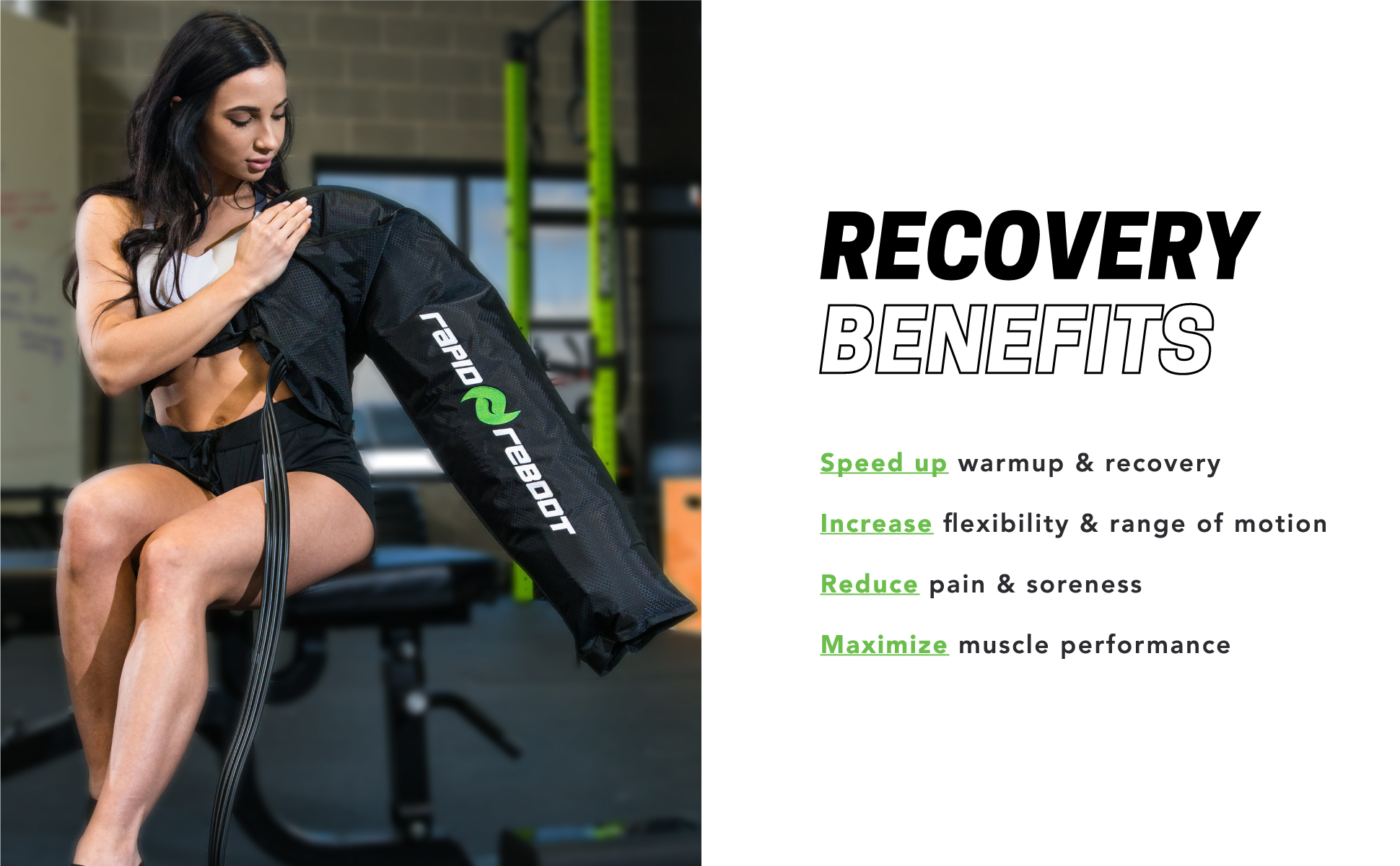
A compression boot is a sleeve containing overlapping air chambers that inflate in a timed sequence from foot to thigh. The squeeze-and-release cycle does three things physiologically. Venous return accelerates as the sleeve pushes deoxygenated blood and metabolic byproducts toward the heart faster than gravity alone. Lymphatic drainage speeds up, reducing exercise-induced swelling and inflammation in the limb. And arterial inflow increases during the release phase, delivering fresh oxygenated blood to the muscle tissue. The net effect is an active flush that works with the body's circulatory system rather than on it. Sessions are typically 15 to 30 minutes, hands-free, and well tolerated for daily use. (These physiological effects are described in the peer-reviewed IPC literature. Consumer compression boot systems are FDA cleared for the temporary relief of minor muscle aches and pains and for temporary increase in circulation.)
Ice baths and cold water immersion
An ice bath is whole-body or lower-body submersion in water typically between 50 and 59 degrees Fahrenheit (10 to 15 degrees Celsius) for 10 to 15 minutes. Cold exposure produces rapid vasoconstriction — surface and deep blood vessels narrow, reducing blood flow to the limbs, and then rebound vasodilation as the body rewarms. The physiological cascade includes reduced tissue swelling, blunted inflammatory signaling, reduced perceived pain, and a pronounced effect on the autonomic nervous system. The subjective effect is powerful: athletes routinely report feeling dramatically better after a cold plunge than after any other recovery modality. That feeling, as we will discuss, is both the strength and the risk of the tool.
Massage guns (percussive therapy)
A massage gun is a handheld device that delivers rapid percussive impacts — typically 1,800 to 3,200 percussions per minute — into localized muscle tissue through various attachments. The mechanism is mechanical tissue manipulation: the rapid percussions are thought to temporarily reduce local muscle tension, improve circulation in the treated area, and provide neuromuscular input that reduces the sensation of tightness. Sessions are targeted (30 to 90 seconds per muscle group) and handheld, which makes them fundamentally different from the systemic, passive modalities above. A massage gun is a tool; compression boots and ice baths are environments.
What the Research Actually Shows for Each Modality
This is where the three tools diverge most clearly, and where the evidence should drive the decision. Grouping the findings by tool makes the strengths and limitations of each obvious.
Compression boots: strong recovery effect, no adaptation cost
The compression-boot research literature is one of the most consistent in the recovery category. Controlled studies repeatedly show reductions in perceived soreness and DOMS in the 24 to 72 hours after hard exercise. Hoffman et al. (2016) showed in JOSPT that peristaltic pulse dynamic compression matched massage for immediate subjective fatigue relief (46(5):320-326). Heapy et al. (2018) confirmed IPC’s recovery benefits in trained populations (Research in Sports Medicine, 26(3):354-364). Pinto et al. (2024, Biology of Sport) confirmed in a meta-analysis that IPC produces significant reductions in muscle soreness markers across multiple controlled studies in trained athletes. Doppler ultrasound studies confirm that IPC accelerates venous return and increases arterial inflow. Blood lactate clearance modestly improves in some studies. These findings describe the IPC technology class as studied in controlled research settings. Consumer compression boot systems, including Rapid Reboot, are FDA cleared for the temporary relief of minor muscle aches and pains and for temporary increase in circulation. Trybulski et al. (2025, Scientific Reports) added direct comparative data in 48 professional combat athletes: higher-pressure IPC (100 mmHg) and cryo-compression both outperformed passive rest for perfusion and elasticity, but higher-pressure IPC was the only intervention that sustained elasticity gains through 48 hours. Notably, 100 mmHg was the highest pressure the study’s device could deliver — the dose-response trend from 25 to 100 mmHg suggests that athletes with access to higher-pressure systems have room to push further along the recovery curve.
Just as important, IPC has no known downside on training adaptation. Unlike cold water immersion, compression boots do not appear to blunt the anabolic signaling that drives muscle growth or the aerobic adaptations that drive endurance improvement. The mechanism is mechanical and circulatory; it does not interfere with the inflammatory signaling cascade that initiates muscle repair and growth. That makes compression boots uniquely suitable as a daily recovery tool during periods when you are actively trying to add strength, add muscle, or build aerobic capacity.
Ice baths: strong for perceived soreness, costly for strength and hypertrophy
Ice baths have genuine recovery benefits that the research clearly supports. They reduce perceived soreness after high-damage exercise, reduce limb swelling in the acute post-exercise window, and for many athletes produce a psychological boost that improves next-day training quality. For team sport athletes managing back-to-back game fatigue, during tournament blocks, and in-season when the priority is being ready to play rather than driving adaptation, ice baths are a legitimate and often excellent tool.
The caveat is substantial, and it is the single most important finding in the recovery literature for strength and physique athletes to understand. Roberts et al. (2015, Journal of Physiology) conducted a 12-week training study comparing two groups of resistance-trained men. Both groups did identical strength training. One group used cold water immersion after every workout; the other group used active recovery. After 12 weeks, the cold water immersion group showed significantly less muscle mass gain, less strength gain, and meaningfully reduced anabolic signaling compared with the active recovery group. Fyfe et al. (2019) later found CWI blunted hypertrophy but not maximal strength in the short term, while Malta et al. (2021) confirmed in a Sports Medicine meta-analysis that CWI consistently impairs resistance training adaptations. The mechanism appears to be that cold exposure blunts the inflammatory cascade and satellite cell activity that initiate muscle repair and growth — precisely the processes you are training to trigger.
Subsequent studies have largely confirmed and extended the Roberts finding. Malta et al.’s 2021 meta-analysis in Sports Medicine concluded that regular post-workout cold exposure reduces long-term hypertrophy and strength gains in resistance-trained athletes. The effect appears to be dose-dependent (more frequent cold exposure, larger blunting) and adaptation-specific (the evidence is strongest for hypertrophy and strength; the effect on endurance adaptations is smaller and less clear).
The practical takeaway is not that ice baths are bad — it is that they are context-dependent. Reflexive post-workout cold exposure after every strength session is probably costing adaptation that the athlete trained hard to earn. Used strategically — during tournaments, between games, in the deload phase of a block, or when the priority is acute performance readiness rather than long-term adaptation — ice baths remain an effective tool. Used indiscriminately during a hypertrophy or strength block, they are one of the few recovery interventions with documented downside.
Massage guns: effective for targeted work, not for systemic recovery
The massage gun research literature is thinner than the IPC or cold water immersion literature, partly because the category is newer and partly because the tool is harder to standardize in a study. What the evidence shows is modest but real. Sams et al. (2023) conducted a systematic review finding that percussive therapy devices show promise for short-term DOMS reduction and flexibility improvement, though the evidence base remains limited compared to pneumatic compression research. A 2021 randomized trial showed percussive therapy was comparable to traditional massage for acute reduction of muscle stiffness after exercise. Studies on long-term performance outcomes are essentially non-existent.
What the massage gun is genuinely excellent for is targeted work on trigger points, acute areas of tightness, and specific muscles that need localized attention. It is also portable, cheap relative to the other tools in this article, and useful as a pre-workout warm-up aid. What it is not is a systemic recovery tool. A massage gun treats one muscle at a time. It cannot flush an entire leg, it cannot improve venous return across the whole lower body, and it does not deliver a passive hands-free recovery session the way compression boots do. For a serious athlete, a massage gun is a complement to a systemic recovery tool, not a replacement for one.
Head-to-Head: The Recovery Tool Comparison Table
This table compares the three modalities across the factors that actually matter for a serious athlete evaluating where to put their recovery time and money.
Factor | Compression Boots | Ice Bath / Cold Plunge | Massage Gun |
|---|---|---|---|
Primary mechanism | Active flush: venous return, lymphatic drainage, arterial inflow | Vasoconstriction, reduced inflammation, blunted pain signaling | Localized percussive tissue manipulation |
Best evidence for | DOMS reduction, swelling, perceived recovery, training-block quality | Acute soreness, recovery between same-day sessions, tournament readiness | Targeted trigger-point relief, acute tightness, warm-up |
Blunts strength/hypertrophy adaptation? | No (no known adaptation cost) | Yes — Roberts 2015 and follow-ups show meaningful blunting | No |
Time per session | 15–30 min, hands-free | 10–15 min, active | 30–90 sec per muscle, handheld |
Systemic or targeted | Systemic (entire lower body) | Systemic (whole body or lower body) | Targeted (one muscle at a time) |
Suitable for daily use? | Yes | No — use strategically | Yes |
Convenience at home | High (set up anywhere) | Low (requires tub, ice, drain) | Very high (portable, battery) |
Approx. upfront cost | $1,195–$1,595 (Rapid Reboot REGEN) | $100 tub to $5,000+ chiller | $100–$600 |
Approx. cost per session (3-yr ownership) | $1.92–$4 per session | $0–$2 (tub) + ice + water | <$1 per session |
Read the table top to bottom and a clear pattern emerges. Each tool has a legitimate role. Compression boots are the broadest-use recovery tool — systemic, daily-safe, no adaptation cost, and well-supported by the research on DOMS and training-block recovery. Ice baths are the strongest tool for acute perceived recovery, with a meaningful caveat about strength and hypertrophy adaptation. Massage guns are the best targeted tool and the cheapest entry point, but they are not a systemic solution. The right answer is almost never just one of the three; it is choosing which tool is the primary systemic recovery modality and which ones fill specific supporting roles.
The Finding Every Strength and Physique Athlete Needs to Understand
If you read only one section of this article, read this one, because it is the most consequential recovery finding of the past decade and it is still not widely understood by serious athletes outside of exercise science circles.
In 2015, a research group led by Llion Roberts at the University of Queensland published a study in the Journal of Physiology that fundamentally changed how sports scientists think about post-workout cold exposure for strength athletes. The design was straightforward and rigorous: resistance-trained men were randomly assigned to one of two recovery protocols after each of their strength training sessions, twice per week for 12 weeks. Group one did 10 minutes of cold water immersion at about 10 degrees Celsius. Group two did 10 minutes of active recovery (light cycling) at the same time points. Training was identical between groups. Diet was monitored. Everything else was controlled.
After 12 weeks, the researchers measured muscle mass, strength gains, and the cellular and molecular markers of anabolic signaling. The active recovery group showed significantly greater gains in muscle mass and strength than the cold water immersion group. Muscle protein synthesis — the process that builds new muscle tissue — was attenuated in the cold-immersion group after each session. Satellite cell activity, which is responsible for repairing and adding to muscle fibers, was reduced. Anabolic signaling through the mTOR pathway was meaningfully blunted. The effect was not small: it was the kind of difference that, compounded over a year or a career, meaningfully alters how much strength and muscle an athlete builds from the same training.
The mechanism appears to be that cold exposure suppresses the acute inflammatory response after resistance exercise. That inflammatory response is not a problem to be eliminated — it is part of the signal that tells the body to repair the trained tissue, add new contractile proteins, and grow back stronger. When cold exposure blunts it, you are blunting the signal to adapt. The muscle damage of the training session still occurs; the recovery and growth response that should follow is diminished.
Subsequent research has largely replicated and extended the finding. Malta et al.’s 2021 meta-analysis in Sports Medicine concluded that regular post-workout cold water immersion impairs long-term muscle adaptation in resistance-trained individuals. Fyfe et al. (2019, Journal of Applied Physiology) found the same effect extends to anabolic signaling and type II (fast-twitch) muscle fiber hypertrophy specifically — the fibers most responsible for strength and explosive power. The effect is dose-dependent: the more frequent the post-workout cold exposure, the larger the blunting. A once-per-week ice bath has a smaller impact than cold exposure after every session.
What does this mean practically? It means that the widespread athlete ritual of "plunge after every workout" is probably costing strength athletes adaptation they trained hard to earn. It also means that compression boots — which work through entirely different mechanisms and do not blunt the inflammatory signaling cascade — are a substantially better default recovery tool during hypertrophy and strength blocks. Cold exposure still has its place: for in-season team sport athletes managing back-to-back games, for tournament blocks where acute readiness matters more than long-term adaptation, or timed 6+ hours away from the strength session. But as a reflexive post-workout habit during a muscle-building or strength-building block, the research is now clear that it is counterproductive.
When to Use Each Tool: A Practical Decision Guide
Based on the research above and on how professional training staffs actually deploy these tools, here is the clearest practical guidance for when each modality is the right answer.
Use compression boots when
You want a systemic recovery flush after a hard session, including on strength or hypertrophy days where blunting the inflammatory response would be counterproductive. You need a daily recovery tool that is safe to use multiple times per week or even multiple times per day. You are in a heavy training block and need to protect next-day readiness across many consecutive sessions. You are traveling, you finished a long run or ride, or you are managing DOMS from heavy eccentric loading. You are a masters athlete whose recovery windows have lengthened with age and who needs every legal recovery edge. You are a clinician or trainer running many athletes through the same recovery protocol efficiently. For the vast majority of serious athletes, compression boots are the primary systemic recovery tool — the base of the stack.
Use ice baths when
You are in-season in a team sport with back-to-back games or a tournament where recovering enough to perform the next day matters more than building long-term adaptation. You are in the final 24 hours before a race or competition and need to feel the best you can, even at the cost of some adaptation. You just finished a high-heat endurance session and need to lower core body temperature quickly. You are in a deload week where training volume is lower and blunting adaptation is not a concern. You have a specific psychological or autonomic benefit from cold exposure that improves your next-day training quality. Avoid routine post-workout cold exposure during a dedicated hypertrophy or strength block, and time cold exposure at least 4 to 6 hours away from strength sessions when possible.
Use a massage gun when
You have a specific trigger point or tight muscle that needs targeted attention — a tight calf after a long run, a knotted trap after a heavy pressing session, a stiff IT band the morning after a hard ride. You are warming up before a session and want to improve tissue pliability in a specific area. You are traveling light and need the most portable recovery tool available. You want an inexpensive complement to a systemic recovery tool. A massage gun is not a substitute for compression boots or for a good sports massage, but it is an excellent complement to both.
Can You Stack Them? The Right Way to Combine Recovery Tools
Most serious athletes end up using more than one recovery modality, and the research supports thoughtful stacking when it is done with the mechanisms in mind. The goal is not to use every tool for every session — it is to let each tool do what it is best at without undermining the others or the training you just did.
A well-designed recovery stack for a serious athlete in a training block might look like this. Compression boots are the daily systemic base: 20 to 30 minutes within an hour of hard sessions, and additional sessions throughout the week as time allows. A massage gun covers targeted trigger-point work whenever a specific area needs attention — typically briefly before sessions to improve tissue pliability, and sparingly after sessions for localized tightness. Ice baths are reserved for specific contexts: in-season tournament use, deload weeks, or acute heat recovery. Sports massage (manual) is booked monthly or bi-weekly for maintenance and to address chronic issues that the home tools cannot fully resolve. Sleep, protein, and hydration are not recovery tools but the foundation underneath all of them, and none of the tools in this article can compensate for neglecting the basics.
The order of use within a single session also matters. If you are using multiple tools on the same day, the general principle is: compression boots first (systemic flush immediately post-exercise), targeted massage gun work next (to address specific trigger points), and cold exposure last if at all, and only in the contexts where the trade-off is justified. Using ice baths immediately after compression boots defeats some of the vasodilation benefit of the boots; separating them by at least an hour preserves more of the benefit of each.
For athletes who want hot or cold therapy delivered in a more targeted way than a full ice bath, Rapid Reboot also makes Revamp gel-filled wraps — individual hot/cold sleeves and flat pads that can be frozen or heated and applied to specific areas. They come in configurations including tube sleeves that slide directly inside the REGEN boots, arm, and hip garments, along with ankle wraps, shoulder wraps, flat pads, and a cold cap. That means a runner with a flaring calf can get compression plus localized cold in the same session, or a lifter with a cranky shoulder can apply a Revamp wrap without submerging the entire body in a tub. For most athletes, Revamps are a more practical and precisely targeted cold-therapy option than a full ice bath.
Why Compression Boots Are the Right Daily Tool
If the theme of this article is matching the right tool to the right job, then the systemic daily recovery job belongs to compression boots, and within that category Rapid Reboot is engineered specifically for the serious athlete who wants the full capability of the tool.
The Rapid Reboot REGEN system reaches 200 mmHg of pressure — double the ceiling of any major competitor. It delivers a 0-to-200 mmHg pressure range with 20 precise levels in 10 mmHg increments — nearly double the ceiling and far wider than the operating range of any major competitor. It is also currently the only system in its tier that allows all four leg chambers — foot, calf, knee, and thigh — to be set to completely independent pressures in the same session, where competitors apply a single global pressure across all chambers. For a runner with a flaring calf and a fresh quad, for a lifter whose hamstrings need deep work but whose calves do not, or for a clinician running mixed populations through the same hardware, that independent control is the entire point of owning a premium system.
The REGEN Boots Package starts at $1,195, and the modular design means athletes can add hip or arm attachments later using the same control unit. At roughly $1.92 to $3.83 per session across three years of regular use, it is also the most cost-efficient systemic recovery tool available to an individual athlete. For the athlete who has read the research above and decided that compression boots belong at the base of their recovery stack, Rapid Reboot is the clearest answer on value, spec, and service.
Frequently Asked Questions
Are compression boots better than ice baths?
For most serious athletes most of the time, yes — for two reasons. First, compression boots do not blunt the strength and hypertrophy adaptations you trained for, while regular post-workout cold exposure does (Roberts et al., 2015). Second, compression boots are safe for daily use and deliver a hands-free systemic recovery session, while ice baths are a more demanding intervention that should be used strategically rather than reflexively. Ice baths still have legitimate uses — in-season tournament recovery, deload weeks, acute heat exposure — but they are not the right default recovery tool for an athlete in an active adaptation block.
Do ice baths really hurt muscle growth?
Yes, when used frequently after strength training. The Roberts 2015 study in the Journal of Physiology demonstrated that 12 weeks of regular post-workout cold water immersion meaningfully reduced strength and muscle mass gains compared with active recovery, even when training was identical between groups. Follow-up research has confirmed the finding. The effect is specific to the context: cold exposure blunts the acute inflammatory signaling that drives muscle repair and growth. Occasional or strategically-timed ice baths have less impact; reflexive post-workout cold exposure during a strength or hypertrophy block meaningfully costs adaptation.
Are compression boots or massage guns better?
They solve different problems and are best used together rather than compared. Compression boots are a systemic hands-free recovery tool that flushes an entire leg (or the full body with attachments) for 20 to 30 minutes. A massage gun is a targeted handheld tool that treats one muscle at a time for 30 to 90 seconds. For systemic daily recovery, compression boots are dramatically more effective. For targeted trigger-point work on a specific muscle, a massage gun is the right tool. The best recovery stack for a serious athlete includes both — compression boots as the systemic daily base, and a massage gun as the targeted complement.
Can I use all three recovery tools?
Yes, and most serious athletes who use any of them end up using more than one. The principle is to let each tool do what it is best at: compression boots as the daily systemic base, massage gun as the targeted complement, and ice baths used strategically for specific contexts rather than reflexively. Time ice baths away from strength sessions (at least 4 to 6 hours) when possible, and avoid the combination of immediate post-strength ice exposure during hypertrophy blocks entirely. The order within a single session should generally be: compression boots first, massage gun for targeted work, ice bath last and only when contextually appropriate.
Which is cheapest per session?
A massage gun is cheapest on an upfront basis ($100 to $600) and cheapest per session if you use it frequently. Compression boots cost more upfront ($1,195 for the Rapid Reboot REGEN Boots Package) but deliver the lowest per-session cost of any systemic recovery tool — about $1.92 to $3.83 per session across three years of regular use, compared with $80 to $150 for a single sports massage or $40 to $65 for a cryotherapy session. Ice baths fall in between, depending on whether you use a basic ice-filled tub (essentially free per session) or a chiller setup (a few dollars of electricity per session after a meaningful upfront cost).
When should I not use compression boots?
Avoid intermittent pneumatic compression if you have an active deep vein thrombosis, severe peripheral artery disease, uncontrolled congestive heart failure, active cellulitis or infection in the limb, or an unhealed fracture. Pregnancy, severe neuropathy, and certain skin conditions call for physician clearance first. Compression boots also do not rehabilitate an acute muscle strain and should not be used in the first 48 to 72 hours of a significant soft-tissue injury. For healthy athletes with no contraindications, daily use is well tolerated and well supported by the research.
The Bottom Line
The three tools in this comparison are not interchangeable and they are not equally suited to the same job. Compression boots are the most broadly effective recovery tool for serious athletes: systemic, hands-free, safe for daily use, well-supported by the research on DOMS and training-block recovery, and — critically — they do not blunt the adaptations you just trained for. Ice baths are powerful for acute perceived recovery and for specific contexts like in-season tournament play, but the research is now clear that routine post-workout cold exposure costs strength and hypertrophy adaptation in athletes actively trying to build them. Massage guns are an excellent targeted tool and the best complement to a systemic recovery base, but they are not themselves a systemic solution.
Each modality occupies a different niche: ice baths excel at acute inflammation control but carry adaptation costs for strength athletes; massage guns offer convenient targeted relief but lack systemic reach; compression boots provide the broadest evidence base for whole-limb recovery with the fewest trade-offs. When selecting a compression system, the differentiators that matter most — pressure range, chamber independence, and protocol control — are where Rapid Reboot’s design aligns most closely with what the research supports.
Key Sources and Further Reading
This article draws on peer-reviewed research and current industry data. Selected sources include:
- Roberts, L. A., et al. (2015). Post-exercise cold water immersion attenuates acute anabolic signalling and long-term adaptations in muscle to strength training. Journal of Physiology, 593(18).
- Hoffman, M. D., et al. (2016). Peristaltic pulse dynamic compression of the legs enhances recovery. JOSPT, 46(5):320-326.
- Fyfe, J. J., et al. (2019). Cold water immersion attenuates anabolic signaling and skeletal muscle fiber hypertrophy, but not strength gain, following whole-body resistance training. Journal of Applied Physiology, 127(5):1403-1418.
- Konrad, A., et al. (2020). The acute effects of a percussive massage treatment with a Hypervolt device on plantar flexor muscles’ range of motion and performance. Journal of Sports Science and Medicine, 19(4), 690-694.
- Sands, W. A., et al. (2014). Peristaltic pulse dynamic compression of the lower extremity enhances flexibility. Journal of Strength and Conditioning Research, 28(4), 1058-1064.
- Trybulski, R., et al. (2025). Effect of pneumatic and cold compression on muscle performance and recovery in combat sports athletes. Scientific Reports, 15, 44993.
- Recovery For Athletes, BarBend, and TrainingPeaks 2025–2026 coverage of recovery modality research.
© 2026 Rapid Reboot. Educational content; not medical advice. Consult a physician before beginning any new recovery protocol.