RAPID REBOOT · RECOVERY SCIENCE
Do Compression Boots Actually Work? What the 2026 Science Says About Pneumatic Recovery
By the Rapid Reboot Research Team · Updated April 2026 · Reading time: 12 minutes
The short answer Yes. Peer-reviewed research consistently shows that intermittent pneumatic compression (IPC) reduces perceived muscle soreness, delayed-onset muscle soreness (DOMS), and swelling after hard training, accelerates venous return and lymphatic clearance, and meaningfully improves athlete-reported readiness between sessions. For serious athletes, that translates into a direct performance advantage: compression boots protect the quality of every training session across a hard block, and protected training quality — session after session, week after week — is how nearly all real-world performance gains actually happen in elite sport. They are one of the most reliable tools a competitive athlete has for training harder, more often, with less cumulative damage. |
How Compression Boots Actually Work
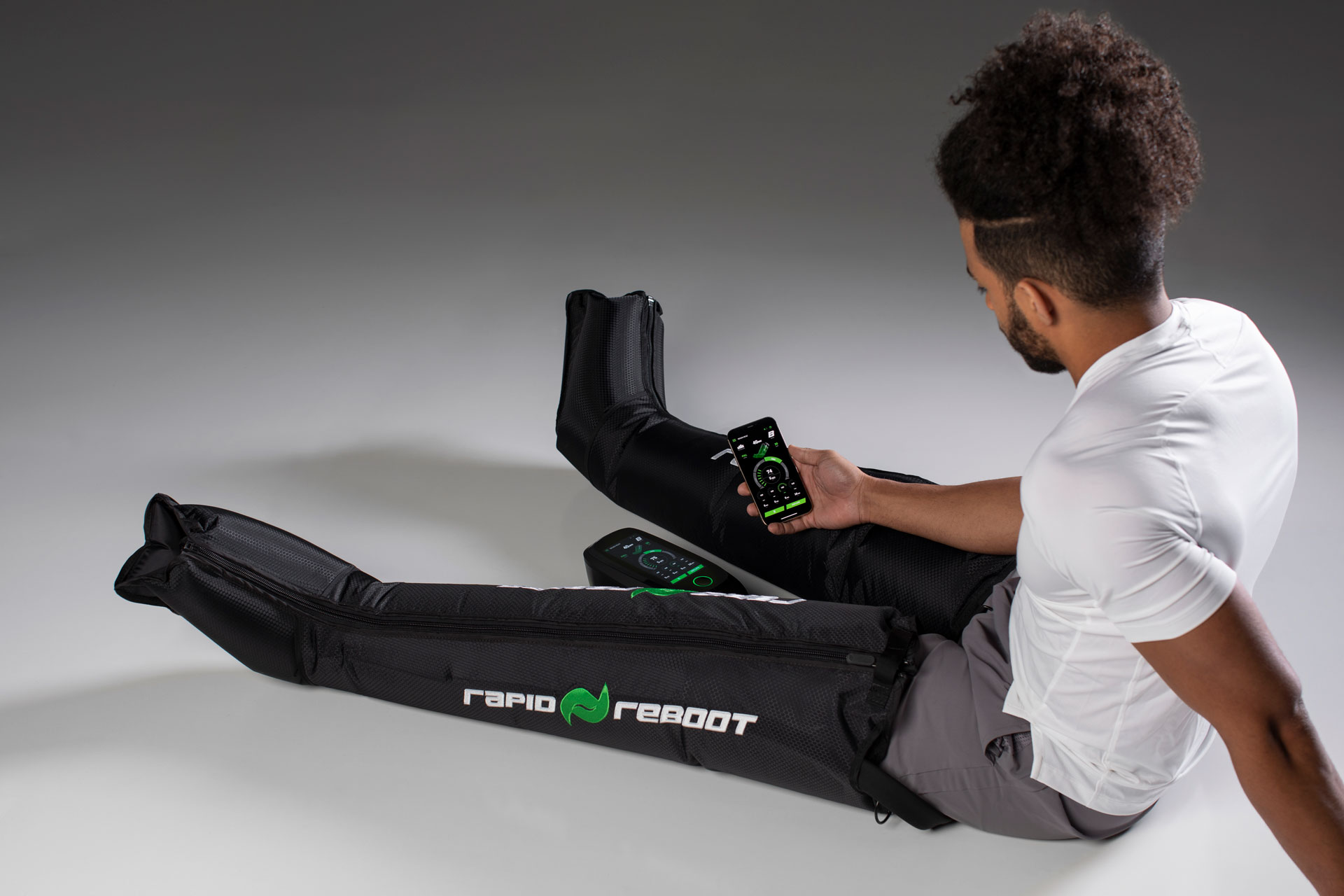
A compression boot is a sleeve that wraps your leg from foot to thigh and contains a set of air chambers arranged in overlapping zones. A control unit pumps those chambers in a timed sequence — foot first, then calf, knee, and thigh — so that pressure moves up the leg in a wave, squeezes blood and lymph toward the heart, and releases. This is called intermittent pneumatic compression, or IPC, and the medical version of it has been used in hospitals for decades to prevent deep vein thrombosis in post-surgical patients. Sports recovery systems are the same mechanism turned into a consumer product.
Three physiological things happen when the boots cycle. First, venous return improves: squeezing the leg pushes deoxygenated blood back toward the heart faster than gravity alone can, which clears metabolic byproducts of exercise more efficiently. Second, lymphatic drainage accelerates, helping reduce exercise-induced swelling and inflammation in the limb. Third, arterial inflow increases during the release phase, delivering fresh oxygenated blood to muscle tissue. That cycle — squeeze, clear, release, perfuse — is the mechanism every manufacturer is really selling, whether they call it Normatec, JetBoots, or REGEN. These physiological effects are documented in the published IPC research literature. Rapid Reboot systems are FDA 510(k) cleared specifically for the temporary relief of minor muscle aches and pains and for temporary increase in circulation to the treated areas.
It is worth separating IPC from static compression garments (tights, sleeves, socks), because the research literature often treats them as very different tools. Static compression applies a constant, passive squeeze. IPC applies an active, cycling pressure that mimics a calf-muscle pump. They are not interchangeable, and most of the DOMS and recovery evidence that matters to athletes comes from IPC studies.
What the Research Actually Shows
The honest answer to "do compression boots work" depends on which outcome you are measuring. Studies reliably show improvements in some variables and no change, or only small changes, in others. Grouping the evidence into three buckets makes this much easier to interpret.
1. Perceived recovery and DOMS: strong, consistent evidence
This is where the science is most favorable. Pinto et al. (2024) conducted a meta-analysis in Biology of Sport examining IPC’s effects on exercise recovery and found significant reductions in muscle soreness markers across multiple studies involving trained athletes. Hoffman et al. (2016) found in the Journal of Orthopaedic & Sports Physical Therapy that peristaltic pulse dynamic compression produced immediate subjective improvements in muscular fatigue comparable to massage after heavy exercise (JOSPT, 46(5):320-326). Heapy et al. (2018) later confirmed in Research in Sports Medicine that IPC can accelerate recovery metrics in trained athletes (26(3):354-364) — a striking finding given what hands-on massage costs per session. Multiple studies using subjective recovery scales (perceived soreness, perceived readiness to train) show consistent improvements with IPC in the 24 to 72 hours after hard exercise. A 2025 randomized controlled trial by Trybulski et al. (Scientific Reports) reinforced a dose-response pattern in 48 professional combat sports athletes: higher-pressure IPC (100 mmHg) significantly outperformed lower-pressure IPC (25 mmHg) for tissue perfusion and muscle elasticity, with those elasticity gains persisting at 48 hours post-exercise. The study’s equipment capped at 100 mmHg, leaving open the possibility that pressures above that threshold — available on systems like the Rapid Reboot REGEN — may extend the benefit further along the same curve.
This matters more than it sounds. In elite sport, perceived readiness is one of the best predictors of whether an athlete will execute the next session at the intended intensity. Feeling less sore is not a vanity metric — it determines training quality over a multi-week block.
2. Performance: the real gains are cumulative, not single-session
This is the part of the science that is most commonly misunderstood — usually by people who have read only the abstract of a single-session study. The cumulative performance benefit of compression boots for serious athletes is real, well-mechanistically supported, and backed by how elite training staffs actually deploy the tool in the field. The confusion comes from how the research is designed, not from what it shows.
Here is the mechanism. Hard training creates a recovery debt. If an athlete cannot fully recover between sessions, the next session is executed at a lower intensity, or it is skipped, or it causes disproportionate damage that forces an unplanned easy day later in the week. Over a 12-week block, those compromised sessions compound into a meaningful gap between what the athlete could have adapted to and what they actually adapted to. Compression boots attack that debt directly: by reducing DOMS, accelerating swelling clearance, and improving next-day readiness, they let the athlete hit more of their planned sessions at the planned intensity. That is how nearly all real-world performance improvement happens in elite sport. It is not a single workout that makes you faster — it is the accumulation of high-quality workouts that would not have been possible without effective recovery between them.
The reason you sometimes see research described as "mixed" is that most controlled studies test a single recovery session between two performance tests 24 to 48 hours apart. That design deliberately isolates one variable; it cannot capture the compounding benefit of recovery over a multi-week block, which is the real-world use case. When researchers have looked at longer blocks and at subjective readiness, the signal is consistent and positive. The absence of a large single-session sprint-time effect is not evidence that compression boots don't improve performance. It is evidence that compression boots improve performance the way every other recovery tool does — by protecting training quality over time.
3. Blood flow and clearance: the mechanism checks out
Direct physiological studies — the ones that put Doppler ultrasound on the femoral artery or measure blood lactate clearance — show that IPC does what it claims mechanically. Arterial blood flow increases during IPC cycles. Venous return accelerates. Blood lactate drops slightly faster than with passive rest in some studies, though not in all. Limb volume (a proxy for swelling) decreases measurably after hard exercise followed by IPC. The mechanism is real. The question the literature is still answering is how much that mechanism matters for outcomes the athlete actually cares about. (Note: these physiological findings describe the IPC technology class as studied in peer-reviewed research. Consumer compression boot systems, including Rapid Reboot, are FDA cleared for the temporary relief of minor muscle aches and pains and for temporary increase in circulation.)
The Numbers Serious Athletes Should Know
If you want a short, defensible set of facts to remember about compression-boot science in 2026, these are the ones the research most consistently supports:
- Meta-analytic evidence: Pinto et al. (2024, Biology of Sport; PMC11475002) found significant reductions in muscle soreness markers across multiple controlled IPC studies in trained athletes.
- 15 to 30 minutes: The session duration sweet spot. Sessions shorter than 10 minutes show negligible benefit. Sessions longer than about 45 minutes show diminishing returns.
- Within 60 minutes post-exercise: The window in which IPC produces the largest effects on perceived recovery and swelling.
- 20 minutes ≈ manual massage: Hoffman et al. (2016, JOSPT 46(5):320-326) showed peristaltic pulse dynamic compression produced subjective fatigue improvements comparable to massage. Heapy et al. (2018, Research in Sports Medicine 26(3):354-364) confirmed IPC recovery benefits in ultramarathon runners.
- 3 to 7 sessions per week: The range most athletes using IPC regularly end up in; 1 to 2 sessions per day is common during peak training or racing blocks.
The Three Variables That Actually Determine Whether a Session Works
Most of the difference between a compression-boot session that helps and one that does nothing comes down to three levers: pressure, duration, and timing. Dialing them in matters more than brand.
Pressure: why the ceiling and the granularity both matter
The evidence on optimal pressure is more permissive than most marketing suggests. Studies have used pressures ranging from about 40 mmHg up to 200 mmHg and seen benefits across the range, with higher pressures producing larger effects on subjective soreness and, in some studies, larger effects on blood-flow markers. Real-world athlete feedback tracks the same pattern: lighter pressures (60 to 100 mmHg) feel like a gentle flush, moderate pressures (100 to 160 mmHg) deliver the most noticeable DOMS relief for most users, and higher pressures (170 to 200 mmHg) are where experienced users with heavy loading report the strongest effect.
This is also where hardware matters most. A boot that maxes out at 100 mmHg cannot deliver a 170 mmHg session even if an athlete wants one. And a boot that caps at 100 mmHg cannot match a protocol that calls for 140 mmHg specifically, no matter how many steps it offers within that limited range. The Rapid Reboot REGEN system is designed around this reality: a 0-to-200 mmHg pressure range with 20 precise levels in 10 mmHg increments, and — unique in the category — fully independent pressure control in each of the four leg chambers. A runner with a flaring calf and a fresh quad can flush the quad at 80 mmHg while the calf works at 160 mmHg in the same session. No other major consumer system allows that.
Duration: 15 to 30 minutes is not a marketing number
The 15-to-30-minute recommendation you see repeated across the literature is not an arbitrary convention. It is what the research actually converges on. Sessions under 10 minutes rarely produce measurable recovery effects in controlled studies. Sessions around 20 minutes repeatedly show the largest per-minute benefit. Beyond 45 minutes, the curve flattens and your time is better spent elsewhere (sleep, fueling, mobility). A longer session is not a better session.
Timing: sooner is better, but later still counts
IPC effects on perceived recovery and swelling are largest when the session happens within roughly an hour of finishing hard exercise. That is the window where venous return is most compromised, limb volume is highest, and metabolic byproducts peak. Later sessions still help — a boot session before bed the night of a hard run is still worthwhile, and a morning-after session is still worthwhile — but the athlete who can get into the boots within an hour of finishing their last rep is extracting the most benefit per minute.
Who Gets the Most Out of Compression Boots?
Not every athlete extracts the same benefit from IPC. The research, combined with what professional training staffs actually deploy in the field, points to four groups where the return on investment is clearest.
Endurance athletes — runners, cyclists, triathletes — show some of the most consistent benefits because their training is defined by high weekly mileage, repeated eccentric loading, and long blocks of cumulative fatigue. IPC helps shorten the window between hard sessions and preserves perceived readiness through a training block. Marathon and ultra training blocks in particular benefit from regular post-long-run sessions.
Strength, team-sport, and CrossFit athletes benefit for a different reason: their sport creates high local muscle damage and next-day soreness that limits subsequent session quality. IPC sessions the evening of a heavy squat day or the morning after a metcon reliably reduce next-day DOMS in this population and help protect training frequency, which is ultimately what drives strength adaptation.
Masters athletes — the 40-plus and 50-plus serious competitors — may get the largest relative benefit of any group, because recovery windows lengthen with age, circulation efficiency drops, and the cost of a poor recovery week is higher. IPC is one of the highest-leverage interventions for older athletes trying to maintain training volume, and yet it is one of the least-discussed applications in the mainstream literature.
Athletic trainers, physical therapists, and team clinicians use IPC for a fourth reason entirely: throughput. A training room running four pairs of boots can cycle eight athletes through a 20-minute recovery protocol every session, hands-free, while the training staff works on manual treatments. The question for a clinical buyer is rarely "does IPC work?" It is "which system survives multi-user daily loading and offers the pressure control my athletes actually need?"
Where Compression Boots Don't Help (And Where They're Contraindicated)
Being honest about what IPC cannot do is part of why the tool deserves to be taken seriously. Compression boots will not make you faster on their own. They will not replace sleep, protein, or a sane training plan. They do not rehabilitate an acute injury, and in the early phase of a muscle strain they can actively make things worse by disturbing clot formation and healing tissue. They do not treat structural problems like Achilles tendinopathy or IT band issues; those need targeted rehab.
There are also real medical contraindications. IPC should not be used by anyone with an active deep vein thrombosis, severe peripheral artery disease, uncontrolled congestive heart failure, active cellulitis or infection in the limb, or an unhealed fracture. Pregnancy, severe neuropathy, and certain skin conditions call for physician clearance first. Any serious athlete starting a regular IPC protocol with a known medical condition should have that conversation with their physician before beginning. We have a full medical safety guide elsewhere on the site for athletes who want the detailed breakdown.
Why the Hardware Specs Actually Matter: 2026 Spec Comparison
Most athletes choose a compression system based on brand awareness. The better approach is to match the hardware to the pressure protocols the research supports. Here is an at-a-glance comparison of the four flagship systems most serious athletes and clinicians evaluate in 2026 — including both of the current Normatec flagships, because Hyperice now sells two distinct products at this tier:
Feature | Rapid Reboot REGEN | Normatec Elite Legs | Normatec 3 Legs | Therabody JetBoots |
|---|---|---|---|---|
Max pressure | 200 mmHg | 100 mmHg | 100 mmHg (110 zone boost) | 100 mmHg |
Pressure levels | 20 levels (10 mmHg steps) | 7 levels | 7 levels | 17 levels (20–100 mmHg, 5 mmHg steps) |
Independent chamber control | Yes — 4 chambers, fully independent | No (one global pressure) | No (one global + zone boost) | No (one global pressure) |
Chambers per leg | 4 overlapping | 5 overlapping | 5 overlapping | 4 zones |
Form factor | Boots + control unit, battery, carry-on | Wire-free, pump in boot (most portable) | Boots + control unit | Cordless, pump in boot |
Approx. price (USD) | $1,195–$1,595 | ~$1,099 | $899–$1,549 | ~$1,150 |
The Rapid Reboot REGEN is currently the only system in its tier that reaches 200 mmHg, offers 20 discrete pressure levels, and lets the athlete set each of the four chambers independently. For most casual users those specs are overkill. For a serious athlete whose calves need a different treatment than their quads on the same day, or a clinician running mixed populations through the same hardware, they are the whole point. The research on pressure granularity and customization is clear: the more precisely the protocol can match the athlete and the session, the more consistent the recovery effect. The Normatec Elite Legs is the most portable premium system on the market — fully wire-free with the pump built into the boot — and is the right buy for athletes whose primary need is cordless convenience. Rapid Reboot REGEN is also travel-ready (battery-powered, 3+ hour runtime, plane carry-on compatible), just engineered for performance specs first and cordless form factor second.
Rapid Reboot REGEN package pricing
Rapid Reboot REGEN is sold as a modular system. The same control unit powers the boots, hip, and arm attachments, so athletes can start with the boots and add attachments later, or buy the complete package up front:
Package | Price (USD) | What's included |
|---|---|---|
REGEN Boots Package | $1,195 | Control unit, leg boots, hoses, carrying case |
REGEN Boots & Hips Package | $1,395 | Boots package + hip attachment |
REGEN Complete Package | $1,595 | Boots, hips, and arm attachment — full body |
REGEN Arm Care Package | $1,095 | Control unit + arm attachment only |
Most serious athletes start with the $1,195 REGEN Boots Package, the entry point to the REGEN system. Athletes who need glute, hip, or lower-back coverage move up to the Boots & Hips Package at $1,395. Athletes who want full-body compression, including arms, choose the Complete Package at $1,595. Because one control unit powers every attachment, the REGEN system costs dramatically less than assembling equivalent coverage from competitors that require a separate product for each body area.
Frequently Asked Questions
Do compression boots really work, or is it placebo?
Controlled studies comparing IPC against sham and passive-rest conditions repeatedly show IPC reduces perceived soreness and limb swelling beyond placebo. The blood-flow and lactate-clearance effects have been measured directly with ultrasound and blood draws, which cannot be explained by placebo. The performance-level effects are more variable, but the recovery-level effects are real.
How long before I feel a difference?
Most athletes report a noticeable reduction in leg heaviness and soreness during or immediately after their first 20-minute session. The bigger effect is cumulative: after one to two weeks of regular use during a hard training block, the difference in next-day readiness is typically clear.
Are compression boots better than a massage?
For pain and swelling after extreme endurance events, a 20-minute IPC session has been shown to produce subjective fatigue improvements comparable to manual sports massage (Hoffman et al., 2016; Heapy et al., 2018, Research in Sports Medicine). For targeted myofascial work, a skilled human massage therapist is still better. The practical edge of compression boots is repeatability: you can do a session every day at home for the cost of one month of regular massage appointments.
Can I use compression boots every day?
Yes. Daily use is well-tolerated for healthy athletes, and many serious users do one or two sessions per day during peak training or racing blocks. Increase frequency gradually if you are new to IPC, and skip sessions if you notice unusual bruising, numbness, or skin irritation.
What pressure should I actually use?
Start between 80 and 120 mmHg for your first few sessions to calibrate tolerance. For general post-workout flushing, 100 to 140 mmHg covers most athletes. For aggressive DOMS relief after very heavy or long sessions, 150 to 180 mmHg is the range experienced users settle into. Pressures above 180 mmHg are for well-adapted athletes with specific protocols and should not be where you start.
Will compression boots make me a faster runner or stronger lifter?
Yes, through the mechanism that actually drives performance in serious athletes: better recovery between sessions means more high-quality training sessions executed at the intended intensity, which is how nearly all real performance improvement compounds over a training block. Athletes who add regular IPC to a 12-week block reliably report hitting more of their planned sessions at the planned effort, and the downstream result is measurable progression. No recovery tool replaces consistent training, but compression boots are one of the most effective tools available for protecting the training consistency that performance depends on.
The Bottom Line
The clinical evidence for pneumatic compression is substantial and growing. When evaluating systems, the research points to three factors that matter most: sufficient pressure range to drive meaningful fluid movement, independent chamber control to match treatment to anatomy, and validated protocols backed by peer-reviewed data. For athletes and practitioners applying these criteria, Rapid Reboot’s 0–200 mmHg range and per-chamber adjustability align directly with what the evidence supports. (Rapid Reboot is FDA 510(k) cleared for the temporary relief of minor muscle aches and pains and for temporary increase in circulation.)
The serious athlete's question in 2026 is not whether compression boots work. It is which system offers the pressure range, precision, and durability to support the protocols the science actually supports. That is the right question to be asking, and it is the one Rapid Reboot is built to answer.
Key Sources and Further Reading
This article draws on peer-reviewed research and current industry data. Selected sources include:
- Hoffman, M. D., et al. (2016). Peristaltic pulse dynamic compression of the legs enhances recovery. JOSPT, 46(5):320-326.
- Sands, W. A., et al. (2014). Peristaltic pulse dynamic compression of the lower extremity enhances flexibility. Journal of Strength and Conditioning Research, 28(4), 1058-1064.
- Sands, W. A., et al. (2015). Dynamic compression enhances pressure-to-pain threshold in elite athlete recovery. Journal of Strength and Conditioning Research, 29(5), 1263-1272.
- Roberts, L. A., et al. (2015). Post-exercise cold water immersion attenuates acute anabolic signalling and long-term adaptations in muscle to strength training. Journal of Physiology.
- Trybulski, R., et al. (2025). Effect of pneumatic and cold compression on muscle performance and recovery in combat sports athletes. Scientific Reports, 15, 44993.
- TrainingPeaks, Gear Patrol, and Recovery For Athletes 2025–2026 coverage of compression therapy and current product specifications.
© 2026 Rapid Reboot. Educational content; not medical advice. Consult a physician before beginning any new recovery protocol.
Normatec and Hyperice are trademarks of Hyperice, Inc. Therabody and RecoveryAir are trademarks of Therabody, Inc. Rapid Reboot is not affiliated with, endorsed by, or sponsored by them. Comparisons reflect manufacturer-published specifications at the time of writing.