RAPID REBOOT · PROTOCOL GUIDE
How to Actually Use Compression Boots: The Complete 2026 Protocol Guide
By the Rapid Reboot Research Team · Updated April 2026 · Reading time: 14 minutes
The short answer Most athletes who own compression boots are using them wrong — not in a way that will hurt them, but in a way that leaves real recovery benefit on the table. The four variables that actually determine whether a session works are pressure, duration, timing, and frequency, and they interact with the training phase you are in. The research converges on a clear protocol: 20 to 30 minute sessions, 100 to 180 mmHg depending on how damaged the muscle is, within 60 minutes of finishing a hard session when possible, 3 to 7 times per week during active training blocks. The details matter, and the right protocol for a Tuesday easy run is different from the right protocol for a post-marathon recovery or a heavy squat day. This guide walks through the full decision tree, including sport-specific templates, a 16-week marathon protocol, a strength-block template, travel recovery instructions, and the warning signs that mean you should adjust or stop a session. |
The Four Variables That Determine Whether a Session Works
The entire art of using compression boots well comes down to dialing in four variables: pressure, duration, timing, and frequency. Each one independently affects the quality of a session, and the right combination depends on what you just did in training and what you are trying to recover for next. Understand these four levers and you can build a protocol for any situation.
1. Pressure: the most important variable
Pressure is the single variable that most directly determines the depth of the recovery effect. The research literature has looked at pressures from 40 mmHg to 200 mmHg and shown benefits across the range, but the pattern is consistent: higher pressures produce larger effects on subjective soreness and on some blood-flow markers, up to the ceiling of what the athlete can comfortably tolerate. Real-world athlete feedback tracks the same pattern. Light pressures (60 to 100 mmHg) feel like a gentle flush and are ideal for easy-day recovery or early-program calibration. Moderate pressures (100 to 150 mmHg) deliver the most noticeable DOMS relief for the majority of athletes. Higher pressures (150 to 200 mmHg) are where experienced athletes with heavy loading see the strongest effect.
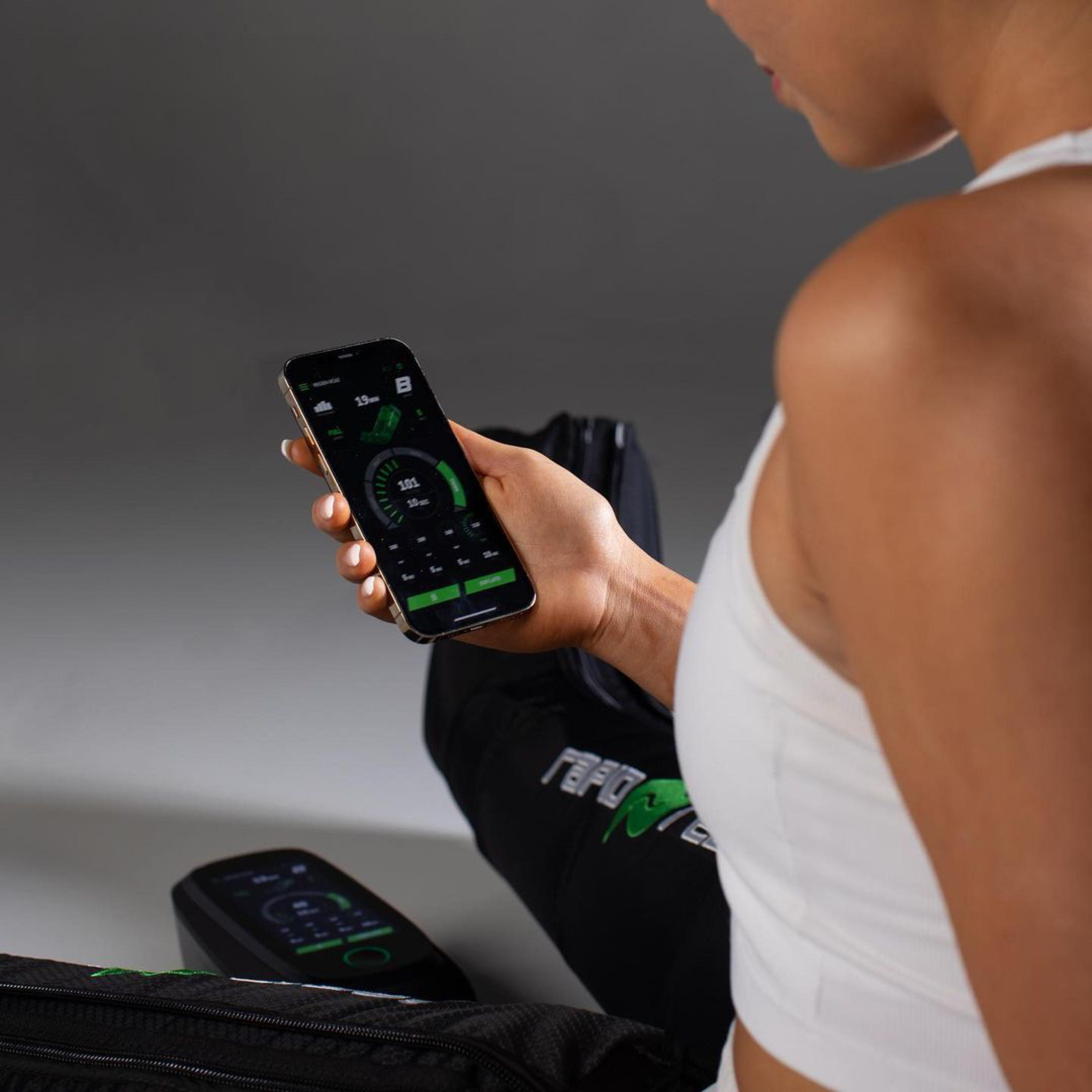
This is the variable where hardware matters most. A boot that caps at 100 mmHg cannot deliver a 170 mmHg session no matter how much the athlete would benefit from one. A boot capped at 100 mmHg cannot reach the 140+ mmHg range the literature supports for aggressive recovery, regardless of how many steps it offers within that limited ceiling. The Rapid Reboot REGEN is designed around this reality: a 0-to-200 mmHg pressure range — nearly double the ceiling of any major competitor — with 20 precise levels in 10 mmHg increments, and — unique in the category — fully independent pressure control in each of the four leg chambers in the same session.
2. Duration: 15 to 30 minutes is where the research converges
The 15-to-30 minute recommendation you see repeated across compression-boot content is not arbitrary marketing convention. It is what the research actually converges on. Sessions under 10 minutes rarely produce measurable recovery effects in controlled studies. Sessions around 20 minutes repeatedly show the largest per-minute benefit — the sweet spot of effect size for time invested. Beyond about 45 minutes, the curve flattens and additional time produces diminishing returns. A 90 minute session is not a better session than a 25 minute session; it is the same session with more of your day spent in boots.
There are legitimate exceptions. Ultramarathon runners sometimes run 40 to 50 minute sessions after very long efforts when the damage profile is exceptional. Cyclists with particularly long rides sometimes benefit from slightly longer sessions because of the prolonged local loading pattern of cycling versus the acute eccentric damage of running. Clinical settings running athletes back-to-back may use shorter sessions (15 minutes) to maximize throughput across multiple users. For the typical serious athlete, 20 to 30 minutes is the right target.
3. Timing: sooner is better, but later still counts
Compression-boot effects on perceived recovery and swelling are largest when the session happens within roughly 60 minutes of finishing hard exercise. That window is when venous return is most compromised, when limb volume is highest, and when metabolic byproducts peak. An athlete who can get into the boots within an hour of finishing their last rep extracts the most benefit per minute of session time.
Sessions later in the day still help. A boot session the evening of a hard morning run still reduces next-day soreness. A morning-after session still accelerates recovery. The effect is smaller than the immediate post-workout window but remains meaningful. For athletes who cannot get into the boots immediately, the rule is: do the session when you can — later is still worth it — but prioritize the immediate window when your schedule allows.
4. Frequency: 3 to 7 sessions per week for serious training blocks
Most serious athletes in active training blocks fall into the 3-to-7-sessions-per-week range, with 1 to 2 sessions per day during peak training or racing weeks. Frequency is dose-dependent: more sessions produce more cumulative benefit, up to the point where the time cost outweighs the recovery return. For most athletes that ceiling is around 7 to 10 sessions per week. Beyond that, additional sessions stop delivering meaningful marginal benefit.
The right frequency depends on the training phase. During a hard block with multiple quality sessions per week, daily or near-daily use is common and supported by the research. During a deload or easy week, 2 to 3 sessions is typically enough. During a race taper, many athletes actually increase frequency because the goal shifts from stimulating adaptation to arriving at the race line as fresh as possible. Masters athletes (40+) often benefit from daily use even in lower-volume blocks because of the age-related changes in recovery capacity.
The Master Protocol Table
Here is the complete 2026 protocol recommendation in a single table, organized by training context. This is the table to bookmark. It covers the full decision tree for pressure, duration, and frequency across the most common training scenarios a serious athlete will face.
Training context | Pressure | Duration | Frequency | Timing |
|---|---|---|---|---|
Easy run / light training day | 80–120 mmHg | 20 min | As desired | Same day |
Moderate hard session | 100–140 mmHg | 20–25 min | Post-session | Within 60 min |
Hard interval / tempo session | 120–160 mmHg | 25–30 min | Post-session | Within 60 min |
Long run (distance/endurance) | 140–170 mmHg | 25–30 min | Post-run + PM | Within 60 min + evening |
Heavy strength / squat day | 140–180 mmHg | 25–30 min | Post-session | Within 60 min |
Metcon / high-volume CrossFit | 130–170 mmHg | 25–30 min | Post-session | Within 60 min |
Post-race recovery (marathon) | 150–200 mmHg | 30–40 min | Daily × 3–5 days | ASAP + daily follow-up |
Race taper (final 7 days) | 100–140 mmHg | 20 min | Daily | Evening |
Deload / easy week | 80–120 mmHg | 20 min | 2–3× per week | Anytime |
Travel / recovery on the road | 100–150 mmHg | 20–30 min | Daily | Hotel room, PM |
A few notes on using this table. Athletes new to compression therapy should start on the lower end of every pressure range for their first week or two, both to calibrate tolerance and to let the tissue acclimate. Experienced athletes in aggressive blocks often push to the upper end of the ranges or beyond. The Rapid Reboot REGEN's 20 precise pressure levels let you dial in any target in the table exactly; systems capped at 100 mmHg and locked to a single global pressure cannot reach the upper end of these targets or adjust chamber by chamber.
Using Independent Chamber Control (When You Have It)
This section applies to athletes using the Rapid Reboot REGEN specifically, because it is currently the only system in its tier that allows fully independent pressure in each of the four leg chambers in the same session. Independent chamber control opens up a set of protocols that are simply not possible on single-pressure systems.
Asymmetric protocols: when calves need more than quads
The most common independent-chamber use case is asymmetric loading. A runner whose calves are flared from hill work but whose quads are fresh benefits from running the calf chamber at 160 mmHg while keeping the quad at 100 mmHg. A lifter whose quads are shredded from heavy squats but whose calves were barely loaded can do the reverse. A cyclist with loaded hip flexors and quads but minimal calf stress can target the upper chambers aggressively while the calf flushes lightly. A masters athlete with one chronically tight section can spend the extra pressure where it matters without overtreating the rest of the leg.
Single-leg asymmetry
Athletes returning from injury, dealing with side-dominance from their sport, or managing an asymmetric training load (a single leg heavier than the other) can run completely different protocols on each leg in the same session. A runner recovering from a calf strain on the right leg might run the right calf at 100 mmHg while the left calf runs at 160 mmHg. A clinician running the same hardware across different patients can adjust per-patient without changing units.
Progressive intensification within a session
Advanced users sometimes run a session that starts with all chambers at a light pressure for the first 5 minutes (warm-up flush), escalates the lower chambers to moderate pressure for the middle of the session, and peaks with aggressive pressure on the most damaged muscle group for the final 10 minutes. The REGEN's precise pressure control in 10 mmHg increments makes this kind of progressive protocol actually executable; systems locked to a single global pressure and a narrower range force compromises that are harder to tune.
The 16-Week Marathon Recovery Protocol
This section is a worked example of how a complete recovery protocol integrates into a training block. The scenario is a 16-week marathon training plan for a serious but non-elite runner targeting a personal best. The plan is broken into four four-week blocks, with the compression-boot protocol adjusting to the training phase.
Weeks 1–4: Base building
Training is building aerobic volume with moderate intensity. Long runs extend from 10 to 14 miles; weekly mileage climbs from 25 to 40 miles. Compression-boot use is moderate: 3 to 4 sessions per week, 20 to 25 minutes, at 100 to 140 mmHg. Primary use case is post-long-run and post-tempo recovery. This phase is about building the habit of using the tool and calibrating comfortable pressure ranges before the volume ramps up.
Weeks 5–8: Volume and tempo phase
Training intensity and volume both climb. Long runs reach 16 to 18 miles; weekly mileage peaks around 45 to 50 miles; one tempo run and one interval session per week. Compression-boot use escalates to 4 to 5 sessions per week, 25 to 30 minutes, at 120 to 160 mmHg. Sessions are prioritized immediately post-long-run and post-interval, with additional sessions on evening recovery days. The independent chamber control becomes valuable here as specific muscle groups start to show asymmetric fatigue patterns.
Weeks 9–12: Peak training
The hardest phase of the block. Long runs reach 18 to 22 miles; weekly mileage peaks around 55 to 65 miles; two quality sessions per week plus a demanding long run. Compression-boot use is at its highest: 5 to 7 sessions per week, 25 to 35 minutes, at 130 to 180 mmHg depending on the session. Post-long-run sessions run at the upper end of the pressure range for maximum DOMS relief; recovery-day sessions stay at moderate pressures. Many athletes add a second (shorter, lighter) evening session after their hardest days. This is the phase where compression boots deliver the most measurable benefit.
Weeks 13–14: Taper
Mileage drops by 20 to 30 percent, intensity remains moderate, and the goal shifts from adaptation to freshness. Compression-boot use stays frequent — 4 to 6 sessions per week — but pressures drop to 100 to 140 mmHg and sessions shorten to 20 to 25 minutes. The emphasis is flushing, not damage repair. Many runners run daily evening sessions during the taper to maximize perceived readiness on race day.
Week 15–16: Race week and post-race
Race week runs daily 20 minute sessions at 80 to 120 mmHg, evening, for perceived freshness. After the marathon, the protocol flips to maximum-intensity recovery mode: 30 to 40 minute sessions at 150 to 200 mmHg, starting within 2 hours of finishing the race and continuing twice daily for the first 3 days, then once daily for the rest of the first post-race week. This is the window where the Rapid Reboot REGEN's high pressure ceiling is most valuable — the damage profile of a marathon is exactly what the 180 to 200 mmHg range is designed to address.
The Strength Training Block Protocol
Strength athletes — powerlifters, weightlifters, and general strength-trained athletes — face a different recovery profile and benefit from a different protocol structure. Heavy compound lifts produce deep eccentric damage and DOMS that peaks 24 to 72 hours after the session, and the recovery tool needs to protect the next session's quality without interfering with the adaptation signal.
Post-heavy-squat protocol
Within 60 minutes of finishing a heavy squat session, a 25 to 30 minute compression session at 140 to 180 mmHg focused on the quad, hamstring, and glute chambers. Experienced lifters running aggressive DOMS protocols push into the 180 to 200 mmHg range for the quad chamber specifically. The Rapid Reboot REGEN's independent chamber control lets the athlete run the quad chamber at 180 mmHg while the calf flushes at 100 mmHg — reflecting the actual load pattern of a squat session rather than forcing a single compromise pressure across the whole leg.
Post-deadlift protocol
Deadlift sessions load the posterior chain hardest — hamstrings, glutes, lower back, and upper back. Leg compression addresses the lower half of this pattern. Athletes who want upper-body recovery as well can add the REGEN hip attachment (for glute and lower back compression) or the full Complete Package for arms and shoulders. Protocol: 25 to 30 minutes post-session at 140 to 170 mmHg, with attachment use as needed.
Day-after sessions
DOMS typically peaks 24 to 48 hours after a heavy session. A second compression session the morning after a hard leg day reliably reduces that peak DOMS and preserves training quality for the next session. Protocol: 20 to 25 minutes at 120 to 150 mmHg, any time of day.
Why this matters more for strength than endurance
Strength athletes have a specific reason to favor compression boots over reflexive cold water immersion that endurance athletes share only partially: regular post-workout cold exposure has been shown to meaningfully blunt strength and hypertrophy adaptations (Roberts et al., 2015). Compression boots work through entirely different mechanisms and do not blunt the inflammatory signaling that drives muscle repair and growth. For any strength athlete actively trying to build strength or muscle, compression boots are the right default daily recovery tool, and ice baths should be used strategically rather than reflexively.
Travel and On-the-Road Recovery Protocol
Serious athletes travel, and travel is itself a recovery challenge. Long flights produce leg swelling and circulatory stasis. Hotel rooms offer limited equipment. Back-to-back competition or training days in unfamiliar environments compound normal recovery demands. Compression boots are one of the best tools for managing this set of problems, and the Rapid Reboot REGEN is specifically engineered to travel.
Pre-flight and post-flight protocol
A compression session before a long flight (2+ hours in the air) can preempt some of the limb swelling that prolonged sitting produces. Protocol: 20 minutes at 80 to 120 mmHg, within an hour of leaving for the airport if possible. A post-flight session on arrival is even more important: 20 to 30 minutes at 100 to 140 mmHg reduces the swelling and stiffness from sitting and accelerates the return to normal circulatory function. Athletes arriving the day before a competition should prioritize this session as soon as they reach their hotel room.
Hotel-room recovery sessions
The Rapid Reboot REGEN is battery-powered with 3+ hours of runtime per charge, ships in a carrying case or duffle bag, and is plane carry-on compatible — meaning it travels as standard gear rather than requiring special arrangements. In a hotel room, a session can run anywhere there is floor space and a bed to lean against. No power outlet required for the duration of the session. Athletes on multi-day trips can charge the unit overnight and run sessions daily without any infrastructure beyond what a typical hotel room provides.
Tournament and multi-day event protocol
Tournaments and multi-day events demand the most from any travel recovery tool: multiple hard efforts per day, short turnaround windows between them, and limited non-training time. The compression-boot protocol for this context prioritizes frequency and convenience over session length. Two or three 15-to-20 minute sessions per day at moderate pressures (100 to 150 mmHg) deliver more total recovery than one long session and fit the available time windows better. Scheduling sessions around meals, film sessions, or any downtime between efforts extracts the most benefit from the available hours.
Adding Hot or Cold Therapy: Revamp Contrast Protocols
Compression boots address venous return, lymphatic clearance, and systemic recovery. They do not, on their own, deliver the localized hot or cold effects that some athletes want layered on top — heat for chronic tight tissue, cold for a specific area of acute soreness, or a contrast sequence for a targeted issue. Rapid Reboot makes that combination possible with Revamp, a line of individual gel-filled hot/cold wraps that come in several configurations: tube sleeves sized to slide inside the REGEN boot, arm, or hip garment, standalone wraps for the ankle and shoulder, a flat pad that works anywhere a flat gel surface is useful, and a cold cap for head and face applications. Each Revamp can be frozen or heated and applied directly, on its own or inside a compression garment, which means you can run localized hot, cold, and compression therapy from the same setup without buying separate equipment for each modality.
Compression + cold (post-hard-session protocol)
For athletes with a specific area of localized soreness after a hard session — a flaring calf, a tight quad, a tender hamstring — place a frozen Revamp tube sleeve inside the REGEN boot over the affected area and run a standard 20-minute recovery session at 120 to 180 mmHg. The compression moves lymph and venous blood out of the limb while the gel sleeve delivers localized cooling to the exact area that needs it. This is a more practical and precisely targeted cold intervention than an ice bath for the common case of a single sore area, and it avoids the systemic cold exposure that Roberts et al. (2015) showed blunts strength and hypertrophy adaptation.
Compression + heat (pre-session or chronic tight tissue)
For pre-session warm-up or chronic tight-tissue work, heat a Revamp tube sleeve in warm water or a dedicated warmer and place it inside the REGEN boot, arm, or hip garment. Run a 10-to-15-minute session at a moderate pressure (80 to 120 mmHg). The combined effect of heat-driven vasodilation and rhythmic compression warms the tissue, improves local perfusion, and prepares the area for training. This is particularly useful for masters athletes, athletes returning from injury, or anyone whose pre-session mobility work benefits from a warmer tissue environment.
Contrast sequencing (hot → cold) inside a single session
Athletes who prefer contrast therapy can run a sequenced protocol on a single station. Start with a heated Revamp sleeve inside the REGEN boot for 8 to 10 minutes at 100 mmHg, then swap in a frozen Revamp sleeve for 10 to 12 minutes at 120 to 150 mmHg. The athlete never moves off the station, the entire protocol takes 20 minutes, and the compression-boot cycle is running throughout — which means the circulatory and recovery benefits documented in the IPC literature are preserved while the localized heat and cold each get their turn.
Targeted Revamp-only use (no boot)
Revamps can also be used standalone, without the compression boot, for body areas that the REGEN garments do not cover. A frozen shoulder wrap for a pitcher after a high-pitch-count outing. A cold cap for heat-illness recovery or migraine relief. A flat pad on the low back after a heavy deadlift day. An ankle wrap for a minor sprain. Because each Revamp is an individual gel wrap rather than a piece of electronic equipment, a training room or a serious athlete can stock exactly the configurations they need and rotate them through a cooler or warmer as the schedule demands.
Warning Signs: When to Adjust or Stop a Session
Compression boots are well tolerated for healthy athletes, and serious adverse events are rare. That said, paying attention to what your body is telling you during and after sessions is part of using the tool well. The signals below are worth knowing.
- Numbness or tingling during a session: Mild tingling is normal during the first few sessions as the tissue acclimates. Persistent or worsening numbness means the pressure is too high for this session or the boot fit is constricting a nerve. Stop the session, reduce the pressure by 20 to 40 mmHg, and restart. If it recurs at lower pressures, take a day off and try again.
- Sharp or cramping pain: Not the normal deep pressure sensation; sharp pain means something specific is wrong. Stop the session immediately and assess. Cramping often indicates dehydration or electrolyte imbalance rather than a problem with the boot itself.
- Unusual swelling after the session: Compression should reduce swelling, not increase it. Worsening swelling after a session is a signal that something is wrong and warrants a physician consult before continuing.
- Skin irritation or marks: Light marks from the boot seams are normal and fade within an hour. Persistent skin irritation, rashes, or broken skin means the boot fit needs adjusting or the session pressure was too high for the skin condition.
- Bruising in unusual patterns: Light bruising from aggressive sessions on particularly damaged muscle is possible and typically benign. Unusual bruising patterns — especially those that appear without aggressive pressure — warrant a medical consult, as they can indicate an underlying circulatory or clotting issue.
For a full breakdown of medical contraindications (DVT history, peripheral artery disease, cellulitis, unhealed fractures, and similar conditions), see our dedicated safety guide. The protocols in this article assume healthy athletes with no contraindications.
Frequently Asked Questions
How long should I use compression boots?
The research converges on 20 to 30 minutes per session as the sweet spot for recovery benefit per minute invested. Sessions under 10 minutes rarely produce measurable effects. Sessions beyond 45 minutes produce diminishing returns. Ultramarathon recovery and post-marathon days are legitimate exceptions where 30 to 40 minute sessions are worthwhile.
What pressure should I use in compression boots?
Start between 80 and 120 mmHg for your first few sessions to calibrate tolerance. For general post-workout flushing, 100 to 140 mmHg covers most athletes. For aggressive DOMS relief after very heavy or long sessions, 150 to 180 mmHg is the range experienced athletes settle into. Pressures above 180 mmHg are for well-adapted athletes with specific protocols and should not be where you start. The Rapid Reboot REGEN offers 20 precise pressure levels in 10 mmHg increments from 10 to 200 mmHg, letting you hit any target exactly; systems with four or seven pressure levels force approximation.
How often should I use compression boots?
3 to 7 sessions per week is the range most serious athletes fall into during active training blocks, with 1 to 2 sessions per day during peak training or racing weeks. Daily use is well tolerated and supported by the research. During deload weeks, 2 to 3 sessions is typically enough. Masters athletes (40+) often benefit from daily use even in lower-volume training blocks.
When should I use compression boots after a workout?
Within 60 minutes of finishing hard exercise is the window where the recovery effect is largest. That is when venous return is most compromised and when metabolic byproducts peak. Sessions later in the day still help — a session before bed the evening of a hard run is still worthwhile, and so is a morning-after session — but the immediate post-workout window produces the most benefit per minute of session time.
Can I use compression boots every day?
Yes. Daily use is well tolerated for healthy athletes and well supported by the research. Many serious users do one or two sessions per day during peak training blocks. Increase frequency gradually if you are new to the tool, and skip sessions if you notice unusual bruising, numbness, or skin irritation.
Can I use compression boots before a workout?
Yes, and there is some evidence that a short pre-workout session (10 to 15 minutes at light pressure, 80 to 100 mmHg) may improve subsequent flexibility and warm-up quality without impairing the workout itself. This is a legitimate but secondary use of compression boots. The dominant and best-supported use case is post-workout recovery, not pre-workout warm-up.
Can I use compression boots while I sleep?
Most manufacturers advise against sleeping in compression boots, and we agree. Extended continuous compression over many hours is a different physiological situation than a 20 to 30 minute session, and the research supporting IPC safety covers defined session lengths, not overnight use. Run your sessions before bed rather than during sleep.
The Bottom Line
Using compression boots well is a matter of matching four variables — pressure, duration, timing, and frequency — to the training context you are in. The research converges on clear defaults: 20 to 30 minutes per session, 100 to 180 mmHg depending on damage, within 60 minutes of hard exercise when possible, 3 to 7 times per week in active training blocks. Those defaults should be the starting point. The nuances — sport-specific templates, the 16-week marathon plan, the strength-block protocol, travel recovery, independent chamber protocols — are where athletes extract the full value of the tool.
Effective compression boot use is about matching the protocol to the moment — lower pressures and shorter sessions for maintenance, higher pressures and targeted chamber settings after heavy training. This guide gives you the frameworks; the key is consistency and listening to your body. Whatever system you use, look for one that lets you fine-tune both pressure and chamber timing independently.
Sources and Further Reading
This guide draws on peer-reviewed research and current sport-specific training literature. Selected sources include:
- Hoffman, M. D., et al. (2016). Peristaltic pulse dynamic compression of the legs enhances recovery. JOSPT, 46(5):320-326.
- Sands, W. A., et al. (2014). Peristaltic pulse dynamic compression of the lower extremity enhances flexibility. Journal of Strength and Conditioning Research, 28(4), 1058-1064.
- Sands, W. A., et al. (2015). Dynamic compression enhances pressure-to-pain threshold in elite athlete recovery. Journal of Strength and Conditioning Research, 29(5), 1263-1272.
- Roberts, L. A., et al. (2015). Post-exercise cold water immersion and long-term strength adaptation. Journal of Physiology.
- Rapid Reboot REGEN product specifications and protocol guidance (rapidreboot.com, 2026).
- TrainingPeaks, BarBend, and Recovery For Athletes protocol coverage (2025–2026).
© 2026 Rapid Reboot. Educational content; not medical advice. The protocols in this guide assume healthy athletes with no medical contraindications. Consult a physician before beginning any new recovery protocol.